by Katinka Barysch
The revolts in Tunisia, Egypt and Libya have brought home to many people that Turkey has become a force to be reckoned with in this region. Turkey enjoys lots of credibility in the Arab world. It has burgeoning trade ties and solid political relations with many Middle Eastern and Mediterranean countries. As the EU scrambles to revamp its own neighbourhood policy, it would do well to work closely with Turkey. Turkey would also gain. Sadly, there is little evidence of such co-operation to date.
Asked at a recent Aspen roundtable in Istanbul whether the EU and Turkey were co-ordinating their responses to the revolts in the Arab world, Ali Babacan, a veteran minister in the Erdogan government, said: "We work a lot with the Americans, like we do on Afghanistan, but not with Europe." The main reason, he said, was that his country's plan to join the EU was going nowhere.
The EU - in acknowledgement of Turkey’s growing international clout - has offered Ankara a foreign policy dialogue outside the accession process. But the dialogue has yet to start in earnest. Most of the interaction between Turkey and the EU still revolves around a largely blocked accession process. Foreign Minister Ahmet Davutoglu - at the same Aspen roundtable - added a second reason why foreign policy co-ordination had been slow to get off the ground. Turkey, he explained, did not bother to work with the EU because the EU's own neighbourhood policy was weak and inconsistent.
Davutoglu and his colleagues in Ankara should reconsider. The uprisings in the Arab world are spurring the EU to rethink its neighbourhood policy (see Charles Grant, 'A new neighbourhood policy for the EU'). They could also wreck Turkey's 'zero problems with the neighbours' approach to its region - which is already in trouble after Turkish attempts to mediate in several regional conflicts failed and Ankara fell out with Israel.
Although today's Turkey likes to see itself as a regional leader, its influence in the Middle East, and even more so in the Maghreb, is still rather fresh and fragile. During the Cold War years, Turkey was largely isolated in its neighbourhood. It clung to its NATO allies while viewing its southern neighbours as sources of Islamic extremism, Kurdish separatism and other potential security threats.
In the 1990s, there were initial attempts to make up with old adversaries like Syria and Iran. These accelerated after the AK party took power in 2002. Turkish mediation efforts, for example between Israel and Syria or Iran and the West, have produced no tangible results. But over the last decade, Turkey has created a web of political, economic and civil society ties with almost all of the countries around its borders. Turkey has scrapped visa requirements for Syrians, Tunisians, Lebanese, Libyans and Moroccans; it is building a free trade zone with various Mediterranean countries; and Turkish traders, builders and bankers are active across the region, as are Turkish business federations and other non-governmental organisations.
Bizarrely, as Kemal Kirisci points out in a recent GMF-IAI paper ('Turkey: Reluctant Mediteranean power'), Turkey's neighbourhood policy has moved from its security-obsessed origins to good old-fashioned European functionalism – the belief that economic integration and lots of low-level exchanges will bring political understanding and stability. The EU's Mediterranean policy has also involved scrapping trade barriers. And it talks about nice things such as democracy and good governance. But in reality it has taken a security-first approach, focusing mainly on fighting terrorism, fundamentalism, and illegal migration.
The revolts in Northern Africa have already forced the EU to think harder about how to help introduce democracy and create economic opportunities in its southern neighbours. Turkey, meanwhile, will probably move security back to the heart of its neighbourhood policy, especially if political upheaval spreads closer to its borders, and if some of the new regimes in the region start quarrelling with Israel or Iran.
Both Turkey and the EU will grapple with finding a balance between the objectives of stability and democracy in their neighbourhood policies. Unlike the EU, Turkey has not in the past claimed to be promoting democracy in the Arab world. Erdogan has managed to gain the admiration of the Arab street - partly through supporting Palestinians and criticising Israel - while at the same time snuggling up to some of the region’s most autocratic rulers, including Colonel Gaddafi, Mahmoud Ahmadinejad and Bashar al-Assad. Erdogan's initial reaction to the Arab uprisings was equally inconsistent. He called on Egypt's President Mubarak to leave and he welcomed Tunisia's move to democracy. But in the case of Libya, Erdogan has been holding out against sanctions and any kind of military intervention. And he has never criticised Ahmadinejad for rigging elections or Assad for clamping down on his opponents. In the new political environment, Turkey's standing in the Arab world will suffer unless its approach to democracy promotion becomes more coherent and consistent.
Turkey's ruling AK party, which itself has some roots in outlawed Islamist forces, has strengthened ties with various Islamist movements in its neighbourhood, including the Muslim Brotherhood in Egypt. The AKP could help turn such movements into electable political parties. However, at a time when the Erdogan government is accused of moving towards religious conservatism and political authoritarianism, collaboration with Islamists elsewhere would scare people inside Turkey and outside. They would ask whether Turkey was trying to promote democracy or Islamism in its foreign relations. Such suspicions would be mitigated if the AKP's ties with Islamists in Egypt and elsewhere were part of an EU-supported democratisation and institution-building programme.
The EU would also benefit greatly from working with Turkey - and not only because Turkey brings valuable regional links and expertise to the table. Having lost much of its kudos by focusing aid and political attentions on various autocratic regimes, the EU could regain soft power by working with Turkey - a country that still enjoys much esteem across the Arab world.
The revamp of respective neighbourhood policies could be an opportunity for the EU and Turkey to get serious about foreign policy co-ordination and thus improve their strained bilateral ties. Co-operation should go beyond political dialogue between Brussels and Ankara and involve business federations, foundations and other non-governmental organisations that can help Mediterranean countries become more stable and prosperous. Without this kind of co-ordination, rivalries and misunderstandings between the EU and Turkey could further undermine their bilateral relationship and the effectiveness of their respective neighbourhood policies.
Katinka Barysch is deputy director of the Centre for European Reform
Wednesday, March 16, 2011


Tuesday, March 15, 2011
What cuts in US defence budget will mean for the transatlantic alliance
by Tomas Valasek
The US defence budget seems set to fall as Washington begins to restore order in its finances. Spending on the military has reached such heights – $700 billion, or 20 per cent of the US federal budget – that it has become too large for deficit-cutters to ignore. Even traditionally pro-defence Republicans now argue that military expenditures need to be reduced along with other government expenses. Europe, too, will feel the pinch: many of the American soldiers currently based on the continent seem certain to go, and some joint weapons programmes will be cancelled. In case of future crises in Europe, NATO’s and the EU’s ability to respond will be tested. The US will expect Europe to lead but European allies themselves have been reducing forces and budgets.
Congress is poised to cut the White House’s request for defence for the fiscal year (FY) 2011 by $15-$20 billion. That might seem low relative to the $700 billion total but of that amount roughly $160 billion is set aside for operations in Iraq and Afghanistan, and will decrease as those conflicts wind down. And much of the remaining money is tied up in non-discretionary spending such as pensions and healthcare for military personnel (the latter alone costs the Pentagon over $50 billion a year). The brunt of the cuts in FY 2011 will therefore fall on the pool of $200-$300 billion that pays for purchases of new equipment, foreign military assistance, overseas bases and non-core military operations. Money spent abroad will be particularly vulnerable to cuts – more and more Americans say that the US government should look after its own rather than, say, wealthy Europeans (all foreign aid is in for big reductions).
The effect of US defence budget cuts on Europe will be five-fold. First, some of the 80,000 US soldiers left in Europe as assurance to NATO allies will most probably leave; Gates said in January 2011 that “it is clear that we have excess force structure in Europe”. The Balts and others in Europe who continue to fear possible trouble with Russia will wonder whether the US has enough forces ready to defend them. But their unease will be tempered by the many military exercises that the US held in the region last year. In 2010, Washington also successfully lobbied the rest of NATO to draft a defence plan for the Baltic. This was done in order to re-affirm US intent to uphold the alliance’s mutual defence pledge, and it seems to have worked: judging by mood at events such as this month’s GLOBSEC conference in Bratislava, the Balts and other Central Europeans are more at ease with Obama. Besides, as Stephen Flanagan of CSIS, a Washington think-tank, points out, “the 50,000 troops that will stay in Europe would be more than double the US ground presence in South Korea, where there is daily risk of imminent war.” Many of the new allies have been busy cutting defence budget themselves: they say that the fiscal crisis leaves them no choice, but the cuts also suggest that they feel little imminent threat from the East. This will make Washington less reticent about withdrawing troops from Europe.
Second, the military assistance that the US provides to help allies to modernise and re-arm will continue to fall. In the past decade, the US generously funded equipment purchases in Europe, with most money going to the new allies. Low-interest US loans allowed Poland to buy F-16 fighter jets, while Romania purchased C-130 cargo planes with US aid. But in recent years, assistance to countries such as Egypt or Pakistan has taken priority – of the $5.4 billion in 'foreign military financing', which the US set aside for 2011, $4.7 billion will go to Middle East and North Africa. The proportion of the aid going to wealthier and less strategic European countries will be slashed further when, as expected, the overall volume of military assistance falls. In the past, US defence companies would have had a decent shot at thwarting cuts in such assistance: they tend to be its main beneficiaries as most of the money ends up with them in the form of procurement orders. But the mood in the US is changing: Republicans in particular argue that the US government should not be in the business of funding new jobs, and that the best job-creation strategy lies in cutting expenses, thus restoring order in the federal budget. Should military assistance to Europe be slashed, as seems likely, programmes such as Romania’s planned purchase of F-16 fighter jets that are financed with US monies would likely be postponed or cancelled. With defence budgets falling in virtually all NATO countries, there is little hope that European allies would pick up the slack.
Third, US personnel on operations in Europe – in Bosnia-Herzegovina and in Kosovo – will likely be reduced or withdrawn altogether. Because their numbers are low to begin with, the short-term impact will be minimal. Only 20 US soldiers remain in Bosnia in a force that once counted 20,000 American troops. The US has about 800 soldiers left in Kosovo, where the overall NATO force is being reduced from 14,000 to 2,500. Should a new crisis break out in the Balkans, the Pentagon will be able to send more soldiers from bases elsewhere in Europe (primarily Germany). But this reserve force too is being reduced. The downsized Pentagon will be far less willing than in the 1990s to lead military operations in Europe. In the future, Washington will look to its allies to assume main responsibility for dealing with the Balkans and other crises on Europe’s periphery. The defense department’s resistance to a no-fly zone in Libya could be a sign of things to come.
Fourth, those European companies that do business in the US will lose some of their orders – but so will their US competitors. Signs of renewed protectionism have been few so far. While the Pentagon recently chose Boeing over a Franco-German consortium EADS to build a new generation of tanker aircraft, “this is mainly because Boeing’s planes were $2 billion cheaper”, says Andrew Koch, an analyst with Scribe Strategies and Advisors, a Washington consultancy. The European companies have worked hard to erase their US competitors’ advantage: the likes of BAE Systems and EADS pledge to build equipment in the US using American workers, so they are likely to have as many members of Congress on their side as their US counterparts. While competition for US defence contracts will toughen, European companies are not necessarily losing ground to US ones.
Fifth, the future of new weapons funded jointly by the US and its allies is in doubt. Already, the Pentagon has announced that it was pulling out of a US-German-Italian project to build a new generation of medium-range missile defences. This is in large part because the project, MEADS, has suffered technical problems. But the Pentagon, in announcing the decision, also cited financial constraints as a factor. The more the US cuts defence spending, the higher the risk that NATO’s own flagship, continent-wide missile umbrella could be at risk. Announced in November 2010, the system envisions combining future US radars and missiles to be stationed mainly in Central Europe with yet-to-be-developed European sensors and interceptors. But few European governments have come forward pledging money for it. It is not obvious why the US Congress would fund a programme to defend European mainland, which the Europeans themselves are unwilling to support.
Politically, cuts in US defence spending are sure to rankle in Europe. A setback to NATO’s missile defences could be particularly divisive, with new allies lamenting a chance to host US military bases, and with NATO losing one of its key initiatives, which it also has been hoping to use to entice Russia into a closer relationship. The effect of US reductions will be compounded by cuts to military spending in Europe: there is a risk that reductions on one side of the Atlantic will be used to justify corresponding cuts across the sea. NATO remains the most powerful military block in the world but it will lose some of its ability to handle multiple crises simultaneously.
The main challenge for US and European defence communities for the next few years will be to keep NATO’s mutual defence pledge credible: this will require allies to prioritise missions and to hone their ability to diffuse crises before they require deployment of large forces. Even if no such crises occur, the Americans and Europeans will be busy managing the political fallout from cancelled procurement programmes and reduced operations. To minimise damage, the Pentagon should keep allies apprised of its cost-cutting measures. For their part, the Europeans need to co-ordinate better their own reductions in defence budgets, so as to make sure that enough money and resources are left to cover any shortfalls that US cuts will create.
Tomas Valasek is director of foreign policy and defence at the Centre for European Reform.
The US defence budget seems set to fall as Washington begins to restore order in its finances. Spending on the military has reached such heights – $700 billion, or 20 per cent of the US federal budget – that it has become too large for deficit-cutters to ignore. Even traditionally pro-defence Republicans now argue that military expenditures need to be reduced along with other government expenses. Europe, too, will feel the pinch: many of the American soldiers currently based on the continent seem certain to go, and some joint weapons programmes will be cancelled. In case of future crises in Europe, NATO’s and the EU’s ability to respond will be tested. The US will expect Europe to lead but European allies themselves have been reducing forces and budgets.
Congress is poised to cut the White House’s request for defence for the fiscal year (FY) 2011 by $15-$20 billion. That might seem low relative to the $700 billion total but of that amount roughly $160 billion is set aside for operations in Iraq and Afghanistan, and will decrease as those conflicts wind down. And much of the remaining money is tied up in non-discretionary spending such as pensions and healthcare for military personnel (the latter alone costs the Pentagon over $50 billion a year). The brunt of the cuts in FY 2011 will therefore fall on the pool of $200-$300 billion that pays for purchases of new equipment, foreign military assistance, overseas bases and non-core military operations. Money spent abroad will be particularly vulnerable to cuts – more and more Americans say that the US government should look after its own rather than, say, wealthy Europeans (all foreign aid is in for big reductions).
The effect of US defence budget cuts on Europe will be five-fold. First, some of the 80,000 US soldiers left in Europe as assurance to NATO allies will most probably leave; Gates said in January 2011 that “it is clear that we have excess force structure in Europe”. The Balts and others in Europe who continue to fear possible trouble with Russia will wonder whether the US has enough forces ready to defend them. But their unease will be tempered by the many military exercises that the US held in the region last year. In 2010, Washington also successfully lobbied the rest of NATO to draft a defence plan for the Baltic. This was done in order to re-affirm US intent to uphold the alliance’s mutual defence pledge, and it seems to have worked: judging by mood at events such as this month’s GLOBSEC conference in Bratislava, the Balts and other Central Europeans are more at ease with Obama. Besides, as Stephen Flanagan of CSIS, a Washington think-tank, points out, “the 50,000 troops that will stay in Europe would be more than double the US ground presence in South Korea, where there is daily risk of imminent war.” Many of the new allies have been busy cutting defence budget themselves: they say that the fiscal crisis leaves them no choice, but the cuts also suggest that they feel little imminent threat from the East. This will make Washington less reticent about withdrawing troops from Europe.
Second, the military assistance that the US provides to help allies to modernise and re-arm will continue to fall. In the past decade, the US generously funded equipment purchases in Europe, with most money going to the new allies. Low-interest US loans allowed Poland to buy F-16 fighter jets, while Romania purchased C-130 cargo planes with US aid. But in recent years, assistance to countries such as Egypt or Pakistan has taken priority – of the $5.4 billion in 'foreign military financing', which the US set aside for 2011, $4.7 billion will go to Middle East and North Africa. The proportion of the aid going to wealthier and less strategic European countries will be slashed further when, as expected, the overall volume of military assistance falls. In the past, US defence companies would have had a decent shot at thwarting cuts in such assistance: they tend to be its main beneficiaries as most of the money ends up with them in the form of procurement orders. But the mood in the US is changing: Republicans in particular argue that the US government should not be in the business of funding new jobs, and that the best job-creation strategy lies in cutting expenses, thus restoring order in the federal budget. Should military assistance to Europe be slashed, as seems likely, programmes such as Romania’s planned purchase of F-16 fighter jets that are financed with US monies would likely be postponed or cancelled. With defence budgets falling in virtually all NATO countries, there is little hope that European allies would pick up the slack.
Third, US personnel on operations in Europe – in Bosnia-Herzegovina and in Kosovo – will likely be reduced or withdrawn altogether. Because their numbers are low to begin with, the short-term impact will be minimal. Only 20 US soldiers remain in Bosnia in a force that once counted 20,000 American troops. The US has about 800 soldiers left in Kosovo, where the overall NATO force is being reduced from 14,000 to 2,500. Should a new crisis break out in the Balkans, the Pentagon will be able to send more soldiers from bases elsewhere in Europe (primarily Germany). But this reserve force too is being reduced. The downsized Pentagon will be far less willing than in the 1990s to lead military operations in Europe. In the future, Washington will look to its allies to assume main responsibility for dealing with the Balkans and other crises on Europe’s periphery. The defense department’s resistance to a no-fly zone in Libya could be a sign of things to come.
Fourth, those European companies that do business in the US will lose some of their orders – but so will their US competitors. Signs of renewed protectionism have been few so far. While the Pentagon recently chose Boeing over a Franco-German consortium EADS to build a new generation of tanker aircraft, “this is mainly because Boeing’s planes were $2 billion cheaper”, says Andrew Koch, an analyst with Scribe Strategies and Advisors, a Washington consultancy. The European companies have worked hard to erase their US competitors’ advantage: the likes of BAE Systems and EADS pledge to build equipment in the US using American workers, so they are likely to have as many members of Congress on their side as their US counterparts. While competition for US defence contracts will toughen, European companies are not necessarily losing ground to US ones.
Fifth, the future of new weapons funded jointly by the US and its allies is in doubt. Already, the Pentagon has announced that it was pulling out of a US-German-Italian project to build a new generation of medium-range missile defences. This is in large part because the project, MEADS, has suffered technical problems. But the Pentagon, in announcing the decision, also cited financial constraints as a factor. The more the US cuts defence spending, the higher the risk that NATO’s own flagship, continent-wide missile umbrella could be at risk. Announced in November 2010, the system envisions combining future US radars and missiles to be stationed mainly in Central Europe with yet-to-be-developed European sensors and interceptors. But few European governments have come forward pledging money for it. It is not obvious why the US Congress would fund a programme to defend European mainland, which the Europeans themselves are unwilling to support.
Politically, cuts in US defence spending are sure to rankle in Europe. A setback to NATO’s missile defences could be particularly divisive, with new allies lamenting a chance to host US military bases, and with NATO losing one of its key initiatives, which it also has been hoping to use to entice Russia into a closer relationship. The effect of US reductions will be compounded by cuts to military spending in Europe: there is a risk that reductions on one side of the Atlantic will be used to justify corresponding cuts across the sea. NATO remains the most powerful military block in the world but it will lose some of its ability to handle multiple crises simultaneously.
The main challenge for US and European defence communities for the next few years will be to keep NATO’s mutual defence pledge credible: this will require allies to prioritise missions and to hone their ability to diffuse crises before they require deployment of large forces. Even if no such crises occur, the Americans and Europeans will be busy managing the political fallout from cancelled procurement programmes and reduced operations. To minimise damage, the Pentagon should keep allies apprised of its cost-cutting measures. For their part, the Europeans need to co-ordinate better their own reductions in defence budgets, so as to make sure that enough money and resources are left to cover any shortfalls that US cuts will create.
Tomas Valasek is director of foreign policy and defence at the Centre for European Reform.
Thursday, February 17, 2011
The EU’s new politics of movement
by Hugo Brady
The freedom enjoyed by EU citizens to live and work in each others' countries is a unique liberty. It is the basis around which European governments have tried to build a single border, a compensatory system of co-operation between police, judges and immigration officers and a common refugee policy. But hardening attitudes towards immigration in many countries and widening policy disagreements between governments and the EU's institutions are exposing fault-lines in this structure. As the cracks threaten to widen over the coming months, policy-makers face some tricky dilemmas.
For a start, some EU governments are struggling with the very concept of free movement. The Dutch government – prodded by far-right politician and coalition kingmaker Geert Wilders – recently announced that it wants to renegotiate the free movement directive. At first sight, the Dutch demand does not seem that outrageous: change the law to allow governments to deport EU nationals with criminal records back to their home countries. The problem is that any re-opening of the 2004 directive risks sparking a plethora of demands from France, Italy or Britain to restrict free movement in other ways. The law was also at the centre of last year's spectacular row between the European Commission and France over arbitrary deportations of Roma. Poorer countries like Poland, Hungary or Romania would be livid, leading to a bitter split between east and west and, possibly, north and south.
Second, the Schengen area – the passport-free travel zone that incorporates most countries where free movement applies – is showing signs of strain. The most startling example of this is the partial takeover of Greece's border with Turkey by Frontex, the EU's border agency, due to a spike in illegal arrivals across the Evros river. Schengen is a bit like the euro, where countries share the benefits of a common good but largely trust each other to run a tight ship at home. However Greece already appears to view the Frontex mission as permanent, throwing up questions of moral hazard amid years of under-investment in its border services. With Italy appealing for similar intervention to help with migratory pressures from Tunisia, we could be witnessing the de facto creation of a European border guard. That development will take many EU countries by complete surprise.
Meanwhile, Bulgaria and Romania are adamant that they should join the Schengen area this year. But despite diplomatic bluster from both governments, neither is yet truly ready to cope with the kind of situation currently evident in Greece. For example, the Romanian port of Constanta risks becoming a Baltimore-on-the-Black Sea if traffickers and smugglers operating in the region can access the Schengen area there under current conditions: organised crime and corruption are commonplace. Moreover, Schengen entry is probably the last piece of leverage the EU has left to encourage both countries to cleanse corruption, reform their judiciaries and step up the fight against serious crime, as they solemnly promised to do in 2007. To argue that these issues are irrelevant to the maintenance of a common border is to dwell on niceties: they are all inherently linked to the rule of law.
Third, the EU's common asylum system is broken. Its cornerstone principle – that those fleeing persecution must apply for refugee status in whatever EU country they first reach – has been undermined by a recent judgement of the European Court of Human Rights on sub-standard refugee conditions in Greece.* The court exposed publically what governments and the European Commission already knew: despite the theoretical existence of common asylum rules, EU countries apply these more according to their national administrative traditions than the spirit of European law. Sadly, there is little agreement between Northern Europeans, the Mediterranean member-states or the Commission about what direction reform should take. While the Commission wants to raise standards and create some exceptions to the first-country-of-arrival rule, most governments oppose any liberalisation on the grounds of cost or moral hazard or both. Indeed the Netherlands wants the rules toughened to make it more, not less, difficult to claim refugee status; Sweden has tightened its own system in response to a rise in support for the far-right; and the UK has opted out of most of the new legislation proposed. This matters because no common border can work without an agreed approach to refugees: asylum seekers have special rights under international law to cross national frontiers. And with a fresh refugee crisis brewing in the EU's North African neighbourhood, it is imperative that the current system be replaced with something workable.
Fourth, the EU is about to embark on a complex and difficult debate about the sharing of police data across borders. EU countries have responded to the loss of control over their borders by creating ever more IT systems for sharing information like fingerprints, DNA records and criminal convictions. Later this year, Viviane Reding, the EU's justice commissioner, will unveil a robust new regime for protecting personal privacy in such cases, as well as an overall agreement with the US on data exchanged for the purposes of counter-terrorism and other serious crimes. The problem here is that the Commission is attempting to regulate the exchange of police files for the first time, using new powers under the Lisbon treaty. The issue is full of potential pitfalls. Given the disparity between national regimes for handling police data, an over-zealous proposal from the Commission would set it on a collision course with national security establishments across the EU and possibly provoke fresh tensions with the US. It is also questionable whether – as the Commission intends – a single EU system covering both commercial data and police records is feasible. It is important that information on private citizens shared across borders between police forces with different cultures and levels of professionalism is subject to credible restrictions. So too is the need for law enforcement bodies to work effectively together across borders. The Commission must exercise subtlety and good judgement.
The EU has a new politics of the interior. Failure to address any of the aforementioned issues correctly would undoubtedly have consequences for free movement and passport-free travel given the current political climate in Europe. It is no co-incidence that both France and the Netherlands have already recently attempted to step up police checks at their borders, in contravention of EU rules. As with the original system underpinning fiscal stability in the eurozone, some EU policies to do with border management, refugee protection and police co-operation were poorly designed. Their consequences, flaws and inherent contradictions will trigger much political and diplomatic confrontation in the months ahead. Many will say this is healthy: policies that have hitherto enjoyed years of cozy consensus and relative anonymity are now subject to proper scrutiny and debate. That is true enough. But the battles ahead are not for the faint-hearted.
Hugo Brady is a senior research fellow at the centre for European Reform
* M.S.S. v Belgium and Greece, http://cmiskp.echr.coe.int/tkp197/view.asp?action=html&documentId=880339&portal=hbkm&source=externalbydocnumber&table=F69A27FD8FB86142BF01C1166DEA398649
The freedom enjoyed by EU citizens to live and work in each others' countries is a unique liberty. It is the basis around which European governments have tried to build a single border, a compensatory system of co-operation between police, judges and immigration officers and a common refugee policy. But hardening attitudes towards immigration in many countries and widening policy disagreements between governments and the EU's institutions are exposing fault-lines in this structure. As the cracks threaten to widen over the coming months, policy-makers face some tricky dilemmas.
For a start, some EU governments are struggling with the very concept of free movement. The Dutch government – prodded by far-right politician and coalition kingmaker Geert Wilders – recently announced that it wants to renegotiate the free movement directive. At first sight, the Dutch demand does not seem that outrageous: change the law to allow governments to deport EU nationals with criminal records back to their home countries. The problem is that any re-opening of the 2004 directive risks sparking a plethora of demands from France, Italy or Britain to restrict free movement in other ways. The law was also at the centre of last year's spectacular row between the European Commission and France over arbitrary deportations of Roma. Poorer countries like Poland, Hungary or Romania would be livid, leading to a bitter split between east and west and, possibly, north and south.
Second, the Schengen area – the passport-free travel zone that incorporates most countries where free movement applies – is showing signs of strain. The most startling example of this is the partial takeover of Greece's border with Turkey by Frontex, the EU's border agency, due to a spike in illegal arrivals across the Evros river. Schengen is a bit like the euro, where countries share the benefits of a common good but largely trust each other to run a tight ship at home. However Greece already appears to view the Frontex mission as permanent, throwing up questions of moral hazard amid years of under-investment in its border services. With Italy appealing for similar intervention to help with migratory pressures from Tunisia, we could be witnessing the de facto creation of a European border guard. That development will take many EU countries by complete surprise.
Meanwhile, Bulgaria and Romania are adamant that they should join the Schengen area this year. But despite diplomatic bluster from both governments, neither is yet truly ready to cope with the kind of situation currently evident in Greece. For example, the Romanian port of Constanta risks becoming a Baltimore-on-the-Black Sea if traffickers and smugglers operating in the region can access the Schengen area there under current conditions: organised crime and corruption are commonplace. Moreover, Schengen entry is probably the last piece of leverage the EU has left to encourage both countries to cleanse corruption, reform their judiciaries and step up the fight against serious crime, as they solemnly promised to do in 2007. To argue that these issues are irrelevant to the maintenance of a common border is to dwell on niceties: they are all inherently linked to the rule of law.
Third, the EU's common asylum system is broken. Its cornerstone principle – that those fleeing persecution must apply for refugee status in whatever EU country they first reach – has been undermined by a recent judgement of the European Court of Human Rights on sub-standard refugee conditions in Greece.* The court exposed publically what governments and the European Commission already knew: despite the theoretical existence of common asylum rules, EU countries apply these more according to their national administrative traditions than the spirit of European law. Sadly, there is little agreement between Northern Europeans, the Mediterranean member-states or the Commission about what direction reform should take. While the Commission wants to raise standards and create some exceptions to the first-country-of-arrival rule, most governments oppose any liberalisation on the grounds of cost or moral hazard or both. Indeed the Netherlands wants the rules toughened to make it more, not less, difficult to claim refugee status; Sweden has tightened its own system in response to a rise in support for the far-right; and the UK has opted out of most of the new legislation proposed. This matters because no common border can work without an agreed approach to refugees: asylum seekers have special rights under international law to cross national frontiers. And with a fresh refugee crisis brewing in the EU's North African neighbourhood, it is imperative that the current system be replaced with something workable.
Fourth, the EU is about to embark on a complex and difficult debate about the sharing of police data across borders. EU countries have responded to the loss of control over their borders by creating ever more IT systems for sharing information like fingerprints, DNA records and criminal convictions. Later this year, Viviane Reding, the EU's justice commissioner, will unveil a robust new regime for protecting personal privacy in such cases, as well as an overall agreement with the US on data exchanged for the purposes of counter-terrorism and other serious crimes. The problem here is that the Commission is attempting to regulate the exchange of police files for the first time, using new powers under the Lisbon treaty. The issue is full of potential pitfalls. Given the disparity between national regimes for handling police data, an over-zealous proposal from the Commission would set it on a collision course with national security establishments across the EU and possibly provoke fresh tensions with the US. It is also questionable whether – as the Commission intends – a single EU system covering both commercial data and police records is feasible. It is important that information on private citizens shared across borders between police forces with different cultures and levels of professionalism is subject to credible restrictions. So too is the need for law enforcement bodies to work effectively together across borders. The Commission must exercise subtlety and good judgement.
The EU has a new politics of the interior. Failure to address any of the aforementioned issues correctly would undoubtedly have consequences for free movement and passport-free travel given the current political climate in Europe. It is no co-incidence that both France and the Netherlands have already recently attempted to step up police checks at their borders, in contravention of EU rules. As with the original system underpinning fiscal stability in the eurozone, some EU policies to do with border management, refugee protection and police co-operation were poorly designed. Their consequences, flaws and inherent contradictions will trigger much political and diplomatic confrontation in the months ahead. Many will say this is healthy: policies that have hitherto enjoyed years of cozy consensus and relative anonymity are now subject to proper scrutiny and debate. That is true enough. But the battles ahead are not for the faint-hearted.
Hugo Brady is a senior research fellow at the centre for European Reform
* M.S.S. v Belgium and Greece, http://cmiskp.echr.coe.int/tkp197/view.asp?action=html&documentId=880339&portal=hbkm&source=externalbydocnumber&table=F69A27FD8FB86142BF01C1166DEA398649
Friday, February 11, 2011
Eurozone governance and the Berlin consensus
by Philip Whyte
A broad consensus appears to have emerged across northern Europe on what ails the eurozone. The region's current predicament, on this view, is the result of fecklessness and irresponsibility in geographically peripheral member-states. Countries in the periphery ran into difficulty because they mismanaged their public finances and lost 'competitiveness'. The road to redemption, on this analysis, is for the peripheral countries to consolidate their public finances and embrace supply-side reforms. The task at EU level is to keep member-states on the straight and narrow by making sure that they comply with the fiscal rules and do what is required to remain 'competitive'. This view, which is having a decisive influence on reforms to the way the eurozone is run, coincides with that of the German government. Let us, then, call it the 'Berlin consensus'.
As an analysis of what ails numerous economies across Europe, the Berlin consensus has much to commend it. There is no question that some countries have mismanaged their public finances. Greece, where governments disguised their profligacy by cooking the data, is the most egregious example. Nor is there any question that many 'peripherals', particularly across Southern Europe, face daunting supply-side challenges: low productivity, high drop-out rates from secondary education, inflexible labour markets, insufficient competition in services markets, rapidly ageing populations and low effective ages of retirement are a toxic brew. All these countries are on unsustainable paths and must push through thoroughgoing economic reforms. Depressingly, their reform efforts have been among the most pedestrian in the EU.
So far, so uncontroversial. Is it right, however, to say that the eurozone would have averted crisis if countries had complied with the Stability and Growth Pact and taken the Lisbon agenda of economic reforms more seriously? Nothing is less certain. France and Germany, which violated the Stability and Growth Pact in 2004, do not face funding difficulties in the government bond markets; Ireland and Spain, which complied with the rules until the crisis broke, do. Nor is it clear that macroeconomic imbalances can be pinned on divergences in national 'competitiveness'. Ireland, a flexible economy that scores highly on many indicators of 'competitiveness', is arguably the most troubled (because the most indebted) country in the eurozone. Italy, which scores worse than Ireland on most indicators of competitiveness, is far less indebted.
The problem with the Berlin consensus is that it does not pay enough attention to the demand-side factors that gave rise to the crisis. The cause of the eurozone's macroeconomic imbalances lay on the demand side. In essence, the problem was that demand grew broadly in line with output at eurozone level, but failed to do so at national level. While demand grew faster than output in the periphery, the reverse was the case in the 'core'. Profligacy in the periphery was funded by thrift in the core. This arrangement suited both sides – for a while. Countries in the periphery enjoyed debt-fuelled booms, while countries like Germany could rely on exports to keep growing (in the face of weak demand at home). Export-led growth in the core and rising indebtedness in the periphery were linked: they were reverse sides of the same coin.
Given the amount of capital that was flooding into the deficit countries, there was always a risk that some of it would be wasted on unproductive investments. And so it was. In Greece, the main agent of waste was the government. But the antics of the government in Greece pale in comparison with those of the private sector elsewhere. In Spain and Ireland, the private sector misallocated capital on a truly epic scale. The agents were over-leveraged banks, in both peripheral and core countries, that funded increasingly speculative investments in the property sector. When the property bubble burst and banks' assets turned sour, the direct and indirect costs blew a hole in the public finance. Ireland's deficits and debt exploded because the government guaranteed the liabilities of highly leveraged banks that were too big for the state to save.
At root, the eurozone crisis boils down to an argument about money. Who should pick up the bill for all the capital that was misallocated in the peripheral countries: feckless borrowers, or reckless lenders? Creditor countries, who are currently in the political driving seat, believe the bill should fall on taxpayers in the deficit countries. But it is not clear that this demand is viable – either economically or politically. Some countries in the periphery are probably insolvent, and the medicine they are currently being prescribed risks pushing them into an ever deeper debt trap. It is hard to see how governments in the periphery can indefinitely push through structural reforms if their economies are contracting and their debt burdens are rising. In the end, therefore, some element of forbearance in the creditor countries appears to be inevitable.
What bearing does all this have for the reform of eurozone governance? First, fiscal consolidation and structural reforms in the periphery may be desirable objectives, but they will not restore the most indebted countries to solvency. Second, extending loans on less than generous terms, as Ireland's partners are doing, will buy time but is unlikely to stave off the inevitable: a default on, or restructuring of, peripheral government debt. Third, it is wrong to portray the eurozone crisis as a problem in the periphery alone. The sovereign debt crisis and the banking crisis are inextricably inter-twined. In the peripheral countries, the link is overt. In the core countries it is suppressed. German banks, for example, are under-capitalised and highly exposed to default in the periphery – a fact that the German government is not keen to discuss.
Since a sovereign debt restructuring in the periphery would have repercussions for the solvency of banks in the core, the eurozone needs a crisis management framework to deal with both eventualities. The eurozone needs to establish a framework for orderly sovereign debt restructuring, which would ensure that private-sector creditors share in the pain. And since sovereign debt restructuring would push some European banks into insolvency, the EU needs to develop plans for dealing with this prospect. Solvent sovereigns in the core, such as Germany, will have to decide whether they want to recapitalise their weaker banks, or allow them to survive in their current vegetative state. And countries across the EU must implement resolution regimes that would allow them to wind up insolvent banks in as orderly a fashion as possible.
Philip Whyte is a senior research fellow at the Centre for European Reform
A broad consensus appears to have emerged across northern Europe on what ails the eurozone. The region's current predicament, on this view, is the result of fecklessness and irresponsibility in geographically peripheral member-states. Countries in the periphery ran into difficulty because they mismanaged their public finances and lost 'competitiveness'. The road to redemption, on this analysis, is for the peripheral countries to consolidate their public finances and embrace supply-side reforms. The task at EU level is to keep member-states on the straight and narrow by making sure that they comply with the fiscal rules and do what is required to remain 'competitive'. This view, which is having a decisive influence on reforms to the way the eurozone is run, coincides with that of the German government. Let us, then, call it the 'Berlin consensus'.
As an analysis of what ails numerous economies across Europe, the Berlin consensus has much to commend it. There is no question that some countries have mismanaged their public finances. Greece, where governments disguised their profligacy by cooking the data, is the most egregious example. Nor is there any question that many 'peripherals', particularly across Southern Europe, face daunting supply-side challenges: low productivity, high drop-out rates from secondary education, inflexible labour markets, insufficient competition in services markets, rapidly ageing populations and low effective ages of retirement are a toxic brew. All these countries are on unsustainable paths and must push through thoroughgoing economic reforms. Depressingly, their reform efforts have been among the most pedestrian in the EU.
So far, so uncontroversial. Is it right, however, to say that the eurozone would have averted crisis if countries had complied with the Stability and Growth Pact and taken the Lisbon agenda of economic reforms more seriously? Nothing is less certain. France and Germany, which violated the Stability and Growth Pact in 2004, do not face funding difficulties in the government bond markets; Ireland and Spain, which complied with the rules until the crisis broke, do. Nor is it clear that macroeconomic imbalances can be pinned on divergences in national 'competitiveness'. Ireland, a flexible economy that scores highly on many indicators of 'competitiveness', is arguably the most troubled (because the most indebted) country in the eurozone. Italy, which scores worse than Ireland on most indicators of competitiveness, is far less indebted.
The problem with the Berlin consensus is that it does not pay enough attention to the demand-side factors that gave rise to the crisis. The cause of the eurozone's macroeconomic imbalances lay on the demand side. In essence, the problem was that demand grew broadly in line with output at eurozone level, but failed to do so at national level. While demand grew faster than output in the periphery, the reverse was the case in the 'core'. Profligacy in the periphery was funded by thrift in the core. This arrangement suited both sides – for a while. Countries in the periphery enjoyed debt-fuelled booms, while countries like Germany could rely on exports to keep growing (in the face of weak demand at home). Export-led growth in the core and rising indebtedness in the periphery were linked: they were reverse sides of the same coin.
Given the amount of capital that was flooding into the deficit countries, there was always a risk that some of it would be wasted on unproductive investments. And so it was. In Greece, the main agent of waste was the government. But the antics of the government in Greece pale in comparison with those of the private sector elsewhere. In Spain and Ireland, the private sector misallocated capital on a truly epic scale. The agents were over-leveraged banks, in both peripheral and core countries, that funded increasingly speculative investments in the property sector. When the property bubble burst and banks' assets turned sour, the direct and indirect costs blew a hole in the public finance. Ireland's deficits and debt exploded because the government guaranteed the liabilities of highly leveraged banks that were too big for the state to save.
At root, the eurozone crisis boils down to an argument about money. Who should pick up the bill for all the capital that was misallocated in the peripheral countries: feckless borrowers, or reckless lenders? Creditor countries, who are currently in the political driving seat, believe the bill should fall on taxpayers in the deficit countries. But it is not clear that this demand is viable – either economically or politically. Some countries in the periphery are probably insolvent, and the medicine they are currently being prescribed risks pushing them into an ever deeper debt trap. It is hard to see how governments in the periphery can indefinitely push through structural reforms if their economies are contracting and their debt burdens are rising. In the end, therefore, some element of forbearance in the creditor countries appears to be inevitable.
What bearing does all this have for the reform of eurozone governance? First, fiscal consolidation and structural reforms in the periphery may be desirable objectives, but they will not restore the most indebted countries to solvency. Second, extending loans on less than generous terms, as Ireland's partners are doing, will buy time but is unlikely to stave off the inevitable: a default on, or restructuring of, peripheral government debt. Third, it is wrong to portray the eurozone crisis as a problem in the periphery alone. The sovereign debt crisis and the banking crisis are inextricably inter-twined. In the peripheral countries, the link is overt. In the core countries it is suppressed. German banks, for example, are under-capitalised and highly exposed to default in the periphery – a fact that the German government is not keen to discuss.
Since a sovereign debt restructuring in the periphery would have repercussions for the solvency of banks in the core, the eurozone needs a crisis management framework to deal with both eventualities. The eurozone needs to establish a framework for orderly sovereign debt restructuring, which would ensure that private-sector creditors share in the pain. And since sovereign debt restructuring would push some European banks into insolvency, the EU needs to develop plans for dealing with this prospect. Solvent sovereigns in the core, such as Germany, will have to decide whether they want to recapitalise their weaker banks, or allow them to survive in their current vegetative state. And countries across the EU must implement resolution regimes that would allow them to wind up insolvent banks in as orderly a fashion as possible.
Philip Whyte is a senior research fellow at the Centre for European Reform
Friday, January 28, 2011
Ireland’s election and the EU: From poster child to enfant terrible?
by Hugo Brady
Ireland will elect a new government on February 25th to replace a discredited administration loathed by most Irish voters. At first sight, it seems unlikely the election will re-open the fundamentals of a bail-out agreed with fellow eurozone members and the IMF last November. The last act of Fianna Fáil, the main party in government since 1997, was to translate the terms of that deal into an initial set of tax hikes and further public spending cuts before leaving office. Nonetheless, the poll – Ireland’s most important for decades – marks a shift in hostility towards the bail-out and the EU in general which its partners would be foolish to ignore.
European benefactors might express shock that Irish attitudes towards the EU have worsened in the wake of the bail-out. To many EU leaders – including José Manuel Barroso, president of the European Commission – they are helping to rescue a country where politicians and regulators, through incompetence or worse, allowed bankers and developers to drive the economy to ruin using other people's money.* That view is correct but cloistered. It takes no account of the part played by the introduction of the euro itself – at a low interest rate hitherto unknown in Ireland – in inflating a runaway property boom. And Ireland's eurozone partners (along with Britain) do expect their money back at a profit, having – they hope – secured the common currency and the unwise investments of their own banks in the process.
Furthermore, the Irish version of events differs sharply from that of its partners, even when adjusted for the natural reluctance of any country to blame itself for its own woes. Most Irish people feel that the rest of the eurozone and European Central Bank imposed a bail-out that their country did not need (Ireland could have limped on until mid-2011 despite its astronomical debts) at an interest rate that it could not afford (5.8 per cent) in an ultimately futile attempt to contain a wider crisis. With a decade of austerity ahead and with no option to default, Ireland's voters gape in disbelief at new demands by continental politicians that it must now raise its low corporation tax rate. By the end of the year, Ireland will have lost 300,000 jobs from a labour market of 2.1 million. The country needs to retain foreign investment as a matter of economic survival.
Perhaps popular disenchantment was always unavoidable, but attitudes amongst Ireland's traditionally pro-EU elites have hardened too. Michael Noonan, the finance spokesperson of Fine Gael – an unambiguously pro-European Christian Democratic party and the one likely to form the bulk of the next government – has characterised the bail-out agreement as being forced on a punch-drunk government by lordly EU and IMF negotiators. Eamon Gilmore, the Irish Labour leader, whose party is likely to secure the finance portfolio in a new coalition, has also demanded a renegotiation of the terms of the agreement, saying the bail-out “clearly won't work. It provides no scope for the Irish economy to grow.”** Even Fianna Fáil – now under a far more effective leader in Micheál Martin, the former foreign affairs minster – will repudiate the agreement in time. And independent commentators in the media and respected think-tanks such as the Economic and Social Research Institute wonder aloud how Ireland will remain a euro country while extricating itself from its current situation.
Irish politics manages to fuse an Italian-style localism, ebullience and idiosyncrasy with the British parliamentary model. Ireland's politicians are usually uninterested in ideology, intensely sensitive to local concerns and poor at strategic thinking, one reason why they were unable to think past the boom. But popular Irish attitudes to national sovereignty closely mirror those of its nearest neighbour. In Britain, euroscepticism became a truly potent political force in the wake of the UK's forced exit from the European Exchange Rate Mechanism in 1992. Since then, pro-Europeans in Britain have dwindled to a small group of progressives. There is every reason to believe that the new generation of Irish politicians entering the scene at this election will view Ireland's difficulties with the euro as the ERM crisis for slow-learners. A flotilla of long-serving parliamentarians are bowing out of politics at this election in favour of younger candidates.
All of this matters doubly because – unlike Britain – Ireland has held a referendum on the future of European integration on average every four or five years since 1987. On the two occasions when Ireland has voted twice on the same treaty, Irish politicians were able to justify this by pointing to the fact that EU membership had been overwhelmingly beneficial to the country. Many voters now recall with bitterness how a desperate government assured them in October 2009 that a second vote on the Lisbon treaty would assist an imminent economic recovery. It will no longer be possible to be so categorial about Ireland's relationship with the EU, also bearing in mind that the country will shortly become a net contributor to the European budget. And the current uncertainty over the fate of the euro itself shows that the EU's constitutional future is by no means settled, as many had hoped when Lisbon was finally ratified.
Make no mistake: it is Ireland's politicians, not the EU, that will rightly be in the firing line on February 25th. But although Ireland may never again be able to serve as an unqualified European success story, the collapse of pro-European sentiment there could well come back to haunt the EU in future. In the 1990s, the IMF learned in Latin America that it is often wise to launch a charm offensive when a new government comes into power in a recipient country undergoing harsh economic adjustment. Ireland's eurozone partners and the ECB would be well advised to follow a similar approach by pre-empting the incoming government's demand for a renegotiation with an offer to lower the interest rate for loans needed to sustain the public finances. In time, the sparing of Irish blushes may save those of many others.
Hugo Brady is a senior research fellow at the Centre for European Reform
* http://www.irishtimes.com/newspaper/breaking/2011/0119/breaking52.html
** http://www.irishtimes.com/newspaper/ireland/2011/0106/1224286876810.html
Ireland will elect a new government on February 25th to replace a discredited administration loathed by most Irish voters. At first sight, it seems unlikely the election will re-open the fundamentals of a bail-out agreed with fellow eurozone members and the IMF last November. The last act of Fianna Fáil, the main party in government since 1997, was to translate the terms of that deal into an initial set of tax hikes and further public spending cuts before leaving office. Nonetheless, the poll – Ireland’s most important for decades – marks a shift in hostility towards the bail-out and the EU in general which its partners would be foolish to ignore.
European benefactors might express shock that Irish attitudes towards the EU have worsened in the wake of the bail-out. To many EU leaders – including José Manuel Barroso, president of the European Commission – they are helping to rescue a country where politicians and regulators, through incompetence or worse, allowed bankers and developers to drive the economy to ruin using other people's money.* That view is correct but cloistered. It takes no account of the part played by the introduction of the euro itself – at a low interest rate hitherto unknown in Ireland – in inflating a runaway property boom. And Ireland's eurozone partners (along with Britain) do expect their money back at a profit, having – they hope – secured the common currency and the unwise investments of their own banks in the process.
Furthermore, the Irish version of events differs sharply from that of its partners, even when adjusted for the natural reluctance of any country to blame itself for its own woes. Most Irish people feel that the rest of the eurozone and European Central Bank imposed a bail-out that their country did not need (Ireland could have limped on until mid-2011 despite its astronomical debts) at an interest rate that it could not afford (5.8 per cent) in an ultimately futile attempt to contain a wider crisis. With a decade of austerity ahead and with no option to default, Ireland's voters gape in disbelief at new demands by continental politicians that it must now raise its low corporation tax rate. By the end of the year, Ireland will have lost 300,000 jobs from a labour market of 2.1 million. The country needs to retain foreign investment as a matter of economic survival.
Perhaps popular disenchantment was always unavoidable, but attitudes amongst Ireland's traditionally pro-EU elites have hardened too. Michael Noonan, the finance spokesperson of Fine Gael – an unambiguously pro-European Christian Democratic party and the one likely to form the bulk of the next government – has characterised the bail-out agreement as being forced on a punch-drunk government by lordly EU and IMF negotiators. Eamon Gilmore, the Irish Labour leader, whose party is likely to secure the finance portfolio in a new coalition, has also demanded a renegotiation of the terms of the agreement, saying the bail-out “clearly won't work. It provides no scope for the Irish economy to grow.”** Even Fianna Fáil – now under a far more effective leader in Micheál Martin, the former foreign affairs minster – will repudiate the agreement in time. And independent commentators in the media and respected think-tanks such as the Economic and Social Research Institute wonder aloud how Ireland will remain a euro country while extricating itself from its current situation.
Irish politics manages to fuse an Italian-style localism, ebullience and idiosyncrasy with the British parliamentary model. Ireland's politicians are usually uninterested in ideology, intensely sensitive to local concerns and poor at strategic thinking, one reason why they were unable to think past the boom. But popular Irish attitudes to national sovereignty closely mirror those of its nearest neighbour. In Britain, euroscepticism became a truly potent political force in the wake of the UK's forced exit from the European Exchange Rate Mechanism in 1992. Since then, pro-Europeans in Britain have dwindled to a small group of progressives. There is every reason to believe that the new generation of Irish politicians entering the scene at this election will view Ireland's difficulties with the euro as the ERM crisis for slow-learners. A flotilla of long-serving parliamentarians are bowing out of politics at this election in favour of younger candidates.
All of this matters doubly because – unlike Britain – Ireland has held a referendum on the future of European integration on average every four or five years since 1987. On the two occasions when Ireland has voted twice on the same treaty, Irish politicians were able to justify this by pointing to the fact that EU membership had been overwhelmingly beneficial to the country. Many voters now recall with bitterness how a desperate government assured them in October 2009 that a second vote on the Lisbon treaty would assist an imminent economic recovery. It will no longer be possible to be so categorial about Ireland's relationship with the EU, also bearing in mind that the country will shortly become a net contributor to the European budget. And the current uncertainty over the fate of the euro itself shows that the EU's constitutional future is by no means settled, as many had hoped when Lisbon was finally ratified.
Make no mistake: it is Ireland's politicians, not the EU, that will rightly be in the firing line on February 25th. But although Ireland may never again be able to serve as an unqualified European success story, the collapse of pro-European sentiment there could well come back to haunt the EU in future. In the 1990s, the IMF learned in Latin America that it is often wise to launch a charm offensive when a new government comes into power in a recipient country undergoing harsh economic adjustment. Ireland's eurozone partners and the ECB would be well advised to follow a similar approach by pre-empting the incoming government's demand for a renegotiation with an offer to lower the interest rate for loans needed to sustain the public finances. In time, the sparing of Irish blushes may save those of many others.
Hugo Brady is a senior research fellow at the Centre for European Reform
* http://www.irishtimes.com/newspaper/breaking/2011/0119/breaking52.html
** http://www.irishtimes.com/newspaper/ireland/2011/0106/1224286876810.html
Thursday, January 20, 2011
Can Greece be saved?
by Katinka Barysch
Will Greece have to restructure its debt? Among most West European economists and investors, this now seems to be a foregone conclusion. The Greeks themselves are not so sure. During a recent visit to Athens, none of the economists and politicians I spoke to thought that restructuring was inevitable or desirable. The Papandreou government looks determined. But to avoid default, Greece would need two things: economic growth and more help from its European neighbours.
Since Greece negotiated its €110 billion financial assistance package with the EU and the IMF last year, it has cut its government deficit by an impressive 6 per cent of GDP. The government has slashed public salaries and pensions, raised VAT and other taxes, and clamped down on ubiquitous tax evasion. Half a dozen big strikes and the occasional outbreak of street fighting notwithstanding, the Greeks have so far remained rather stoic in the face of this unprecedented belt tightening. Most realise that change is needed and hardship inevitable.
The other reason why Greeks have so far stayed calm is that the worst is yet to come. While civil servants, truckers and some other groups felt immediate pain, the population at large has not yet suffered unbearably. After 15 years of rising salaries, most Greeks can cope with an initial drop in income. Those who lose their job or business can usually rely on a tightly knit family network for support.
Greece, however, is not even half way through its deficit cutting programme. The total need for adjustment is 13-15 per cent of GDP. Cutting the first 20 or 30 per cent out of any budget is relatively easy – especially in a budget that contains as much flab as the Greek one. The public sector is overstaffed and, in many places, overpaid; pension entitlements are generous; although 60 per cent of the population lives in the capital, Greece has over 1,000 municipal administrations and 52 regional ones (a new law will cut those numbers by two-thirds); the country’s 150 public hospitals are accounting-free zones, which has contributed to spiralling healthcare costs; public enterprise such as the railways are black holes for government subsidies.
Once the most glaring inefficiencies have been removed, however, further reductions will get a lot harder. After the fat is gone, the government will have to cut bone. Papandreou needs to perform this operation at a time when the economy is in deep recession: by the end of this year, GDP will have contracted by as much as 10 per cent; unemployment is heading towards 15 per cent; among younger people, one in three is out of work; thousands of businesses are closing down every month.
Even if the government managed to stay on track with its plans for budget consolidation, public debt would continue to rise inexorably, to over 150 per cent of GDP by the end of this year. Greece will only stand a chance of generating the revenue needed to service such high debt if it returns to economic growth, and quickly.
The bad news is that in order to regain its competitiveness Greece will require an internal ‘devaluation’ – a fall in real wages relative to its trading partners. Such wage compression will dampen consumption and could even lead to damaging deflation. And it would not even address the deeper problem that Greece makes few things that people in other countries want to buy. Growth since the 1990s was led by consumption and fuelled by cheap foreign credit. To move to a more sustainable growth model, the country requires higher value-added industries and massive foreign investment. Neither will materialise without very thorough economic and institutional reforms. “In terms of institutions, infrastructure and corruption, Greece looks a bit like a third world country”, sighs one Greek fund manager based in London.
The somewhat better news is that Greece’s economy is so inefficient that a series of straightforward changes could kick-start an economic expansion. “In many sectors, our economy resembles Soviet central planning”, explains Yannis Stournaras, who runs the IOBE institute for economic and industrial research. “If we remove stifling regulation and bureaucracy, the economy’s dynamism will be unbound.” IOBE has calculated that liberalisation of the most heavily shackled sectors and professions would lift output by 10 per cent over four years, and probably more once dynamic, growth-boosting effects are taken into account.
Having implemented a first bout of budget-cutting policies, the Papandreou government is now setting to work on structural reforms. If things go according to plan, some 70 ‘closed shop’ professions, from lawyers to pharmacists and civil engineers, will lose many of their privileges and protections. Hiring and firing workers will get easier across the board. State enterprises will be restructured, downsized and sold off. Red tape for businesses will be cut. New incentives will boost investment in green energy, high-end tourism and other potential growth industries.
These plans are already creating fierce opposition from the highly organised groups that will be directly affected. The two main political parties, but Pasok in particular, rely on the trade unions and professional bodies for their core support. “Attacking the closed-shop professions means civil war within Pasok”, predicts Loukas Tsoukalis, head of Eliamep, a think-tank in Athens. Already, some Pasok MPs are grumbling that the reforms are now going too far, too fast. More strikes are inevitable.
Curiously, Greeks tend to sympathise with the plight of even the most molly-coddled public sector workers and privileged professionals. Faced with rising opposition within his own party and public restiveness, Papandreou’s resolve may yet falter.
Even if it does not, Papandreou will face the immovable object of his own state administration. Structural reforms will only boost growth if they are implemented swiftly and effectively. The chances of this happening are slim. A law going back to the post-dictatorship days makes the dismissal of civil servants illegal; even sacking public sector workers who do not strictly speaking enjoy civil service status is considered politically impossible. Each administration since the 1980s has added ‘its’ people to an already outsized state apparatus, often in return for votes and political support. The result is a public sector that is not only hopelessly bloated (roughly 800,000 out of a workforce of five million) but one that is infused with a sense of entitlement, rather than public duty.
Until and unless growth resumes, Greece will struggle to cope with its stifling debt burden. Greeks hope that the EU will step in again to tide the country over until the economy recovers. Many hope that Germany will drop its opposition to joint eurozone bonds, which would help to lower the interest rate at which Greece borrows and refinances its debt. Others suggest that the EU could ‘front-load’ regional aid to boost Greek investment over the next couple of years.
If no further EU help is forthcoming, or the debt burden proves unsustainable, Greece may yet be forced to negotiate a rescheduling or restructuring with its creditors. Since Greek politicians are loath to consider the default option publicly, this would come as a shock to many ordinary Greeks. Many might be directly affected if (as seems likely) a public debt restructuring triggers a crisis within the Greek banking sector and social security funds. Most Greeks would consider default as a terminal blow to the country’s standing inside the EU.
Greeks have traditionally been very pro-EU, and not only because the country has been one of the biggest recipients of EU structural funds since the 1980s. All political parties, with the exception of the Communists, are in favour of more European integration. Remarkably few Greeks have so far blamed the EU (or the IMF for that matter) for the hardship they are going through – although Germans, and Chancellor Merkel in particular, are deeply unpopular for dithering over the bail-out and lecturing the Greeks about their allegedly lazy and lavish ways.
If Greece was forced to restructure, politicians and public opinion could quickly turn against the EU. “The Greeks would say: We’ve been through pain and austerity, and now you drop us”, predicts Panagiotis Ioakeimidis, professor at Athens university and an EU specialist. Some Greeks fear that after default, Greece’s membership in the euro, and the EU itself, may be questioned. That is why the Greeks will hold out fiercely against any pressure to consider restructuring.
Katinka Barysch is deputy director of the Centre for European Reform
Will Greece have to restructure its debt? Among most West European economists and investors, this now seems to be a foregone conclusion. The Greeks themselves are not so sure. During a recent visit to Athens, none of the economists and politicians I spoke to thought that restructuring was inevitable or desirable. The Papandreou government looks determined. But to avoid default, Greece would need two things: economic growth and more help from its European neighbours.
Since Greece negotiated its €110 billion financial assistance package with the EU and the IMF last year, it has cut its government deficit by an impressive 6 per cent of GDP. The government has slashed public salaries and pensions, raised VAT and other taxes, and clamped down on ubiquitous tax evasion. Half a dozen big strikes and the occasional outbreak of street fighting notwithstanding, the Greeks have so far remained rather stoic in the face of this unprecedented belt tightening. Most realise that change is needed and hardship inevitable.
The other reason why Greeks have so far stayed calm is that the worst is yet to come. While civil servants, truckers and some other groups felt immediate pain, the population at large has not yet suffered unbearably. After 15 years of rising salaries, most Greeks can cope with an initial drop in income. Those who lose their job or business can usually rely on a tightly knit family network for support.
Greece, however, is not even half way through its deficit cutting programme. The total need for adjustment is 13-15 per cent of GDP. Cutting the first 20 or 30 per cent out of any budget is relatively easy – especially in a budget that contains as much flab as the Greek one. The public sector is overstaffed and, in many places, overpaid; pension entitlements are generous; although 60 per cent of the population lives in the capital, Greece has over 1,000 municipal administrations and 52 regional ones (a new law will cut those numbers by two-thirds); the country’s 150 public hospitals are accounting-free zones, which has contributed to spiralling healthcare costs; public enterprise such as the railways are black holes for government subsidies.
Once the most glaring inefficiencies have been removed, however, further reductions will get a lot harder. After the fat is gone, the government will have to cut bone. Papandreou needs to perform this operation at a time when the economy is in deep recession: by the end of this year, GDP will have contracted by as much as 10 per cent; unemployment is heading towards 15 per cent; among younger people, one in three is out of work; thousands of businesses are closing down every month.
Even if the government managed to stay on track with its plans for budget consolidation, public debt would continue to rise inexorably, to over 150 per cent of GDP by the end of this year. Greece will only stand a chance of generating the revenue needed to service such high debt if it returns to economic growth, and quickly.
The bad news is that in order to regain its competitiveness Greece will require an internal ‘devaluation’ – a fall in real wages relative to its trading partners. Such wage compression will dampen consumption and could even lead to damaging deflation. And it would not even address the deeper problem that Greece makes few things that people in other countries want to buy. Growth since the 1990s was led by consumption and fuelled by cheap foreign credit. To move to a more sustainable growth model, the country requires higher value-added industries and massive foreign investment. Neither will materialise without very thorough economic and institutional reforms. “In terms of institutions, infrastructure and corruption, Greece looks a bit like a third world country”, sighs one Greek fund manager based in London.
The somewhat better news is that Greece’s economy is so inefficient that a series of straightforward changes could kick-start an economic expansion. “In many sectors, our economy resembles Soviet central planning”, explains Yannis Stournaras, who runs the IOBE institute for economic and industrial research. “If we remove stifling regulation and bureaucracy, the economy’s dynamism will be unbound.” IOBE has calculated that liberalisation of the most heavily shackled sectors and professions would lift output by 10 per cent over four years, and probably more once dynamic, growth-boosting effects are taken into account.
Having implemented a first bout of budget-cutting policies, the Papandreou government is now setting to work on structural reforms. If things go according to plan, some 70 ‘closed shop’ professions, from lawyers to pharmacists and civil engineers, will lose many of their privileges and protections. Hiring and firing workers will get easier across the board. State enterprises will be restructured, downsized and sold off. Red tape for businesses will be cut. New incentives will boost investment in green energy, high-end tourism and other potential growth industries.
These plans are already creating fierce opposition from the highly organised groups that will be directly affected. The two main political parties, but Pasok in particular, rely on the trade unions and professional bodies for their core support. “Attacking the closed-shop professions means civil war within Pasok”, predicts Loukas Tsoukalis, head of Eliamep, a think-tank in Athens. Already, some Pasok MPs are grumbling that the reforms are now going too far, too fast. More strikes are inevitable.
Curiously, Greeks tend to sympathise with the plight of even the most molly-coddled public sector workers and privileged professionals. Faced with rising opposition within his own party and public restiveness, Papandreou’s resolve may yet falter.
Even if it does not, Papandreou will face the immovable object of his own state administration. Structural reforms will only boost growth if they are implemented swiftly and effectively. The chances of this happening are slim. A law going back to the post-dictatorship days makes the dismissal of civil servants illegal; even sacking public sector workers who do not strictly speaking enjoy civil service status is considered politically impossible. Each administration since the 1980s has added ‘its’ people to an already outsized state apparatus, often in return for votes and political support. The result is a public sector that is not only hopelessly bloated (roughly 800,000 out of a workforce of five million) but one that is infused with a sense of entitlement, rather than public duty.
Until and unless growth resumes, Greece will struggle to cope with its stifling debt burden. Greeks hope that the EU will step in again to tide the country over until the economy recovers. Many hope that Germany will drop its opposition to joint eurozone bonds, which would help to lower the interest rate at which Greece borrows and refinances its debt. Others suggest that the EU could ‘front-load’ regional aid to boost Greek investment over the next couple of years.
If no further EU help is forthcoming, or the debt burden proves unsustainable, Greece may yet be forced to negotiate a rescheduling or restructuring with its creditors. Since Greek politicians are loath to consider the default option publicly, this would come as a shock to many ordinary Greeks. Many might be directly affected if (as seems likely) a public debt restructuring triggers a crisis within the Greek banking sector and social security funds. Most Greeks would consider default as a terminal blow to the country’s standing inside the EU.
Greeks have traditionally been very pro-EU, and not only because the country has been one of the biggest recipients of EU structural funds since the 1980s. All political parties, with the exception of the Communists, are in favour of more European integration. Remarkably few Greeks have so far blamed the EU (or the IMF for that matter) for the hardship they are going through – although Germans, and Chancellor Merkel in particular, are deeply unpopular for dithering over the bail-out and lecturing the Greeks about their allegedly lazy and lavish ways.
If Greece was forced to restructure, politicians and public opinion could quickly turn against the EU. “The Greeks would say: We’ve been through pain and austerity, and now you drop us”, predicts Panagiotis Ioakeimidis, professor at Athens university and an EU specialist. Some Greeks fear that after default, Greece’s membership in the euro, and the EU itself, may be questioned. That is why the Greeks will hold out fiercely against any pressure to consider restructuring.
Katinka Barysch is deputy director of the Centre for European Reform
Monday, January 17, 2011
Euro crisis: In defence of investors
by Simon Tilford
The eurozone’s fiscal position is better than the US and UK, and the crisis-hit members of the currency union are doing more to strengthen their public finances than either of these countries. So why are borrowing costs so much higher for countries in the eurozone periphery than for Britain and America? Portugal and Greece have lower public deficits than the US, so why do investors fear for their solvency, but not that of the US?
These questions are being put with increasing frustration by eurozone economists, from both the public and private sectors, as well as by policy-makers such as Juergen Stark at the European Central Bank. The inference is that investors are judging countries by different standards. Why else would investors continue to lend to the likes of the ‘profligate’ US and UK, but punish countries whose fundamentals are sounder? Such irrational behaviour by investors, it is argued, is unfairly derailing the hard work being done by governments in the eurozone. Are such frustrations justified?
Investors do appear, superficially at least, to be harsh in their attitude towards the eurozone. As Table 1 below shows, the eurozone's aggregate budget deficit is lower than in the UK or the US; its aggregate debt is marginally higher than in the UK, but lower than in the US; and in struggling Spain, public debt is lower than in both the US and the UK.

But anything more than a very superficial analysis shows why investors are right to be concerned about the eurozone. First, there is no federal eurozone budget, so the aggregate budget deficit is only of so much interest to investors. Second, it is countries’ ability to service their debts going forward that determines the risk premium demanded by investors, and to a large extent this depends on their economic growth prospects. While the crisis-hit eurozone economies have made more progress in reducing their borrowing than did either the UK or US, this has been at the cost of economic stagnation. Third, sovereign investors are not just concerned about public debt, but levels of private indebtedness too. They fear that if economic growth remains very weak, governments will end up being liable for some of the private debt.
Eurozone economic growth was a respectable enough 1.7 per cent in 2010 (see Table 2). This was well below the US, but about the same as the UK. However, the eurozone figures masked huge differences. Germany, which accounts for a third of the currency union’s GDP, expanded by 3.6 per cent, whereas Greece’s economy contracted steeply and a number of others barely grew. Stripping out Germany, eurozone economic growth was actually just 1 per cent in 2010. Indeed, the eurozone is still a long way from returning to its pre-crisis level of economic activity: in the third quarter of 2010 eurozone GDP was still 3.2 per cent lower than in the first quarter of 2008. This was better than the UK but far worse than the US, whose economy was almost 2 per cent larger in the third quarter of 2010 than at the outset of the downturn. Not only is real GDP in some of the struggling economies still way below their pre-crisis peaks, but there is little chance of them returning to pre-crisis levels any time soon.

Are investors right to be so pessimistic about the economic growth prospects of the struggling member-states? Yes, because their prospects of economic recovery rest on a strong rise in exports, but the principal way of bringing this about – real devaluation within the eurozone – threatens economic stagnation and rising debt burdens. Because of their membership of the currency union they cannot devalue their currencies, so must reduce their wages and prices relative to their eurozone counterparts. The problem is that this will depress income and lead to deflationary pressures. This, in turn, will make it hard to bring down deficits on a sustained basis (irrespective of how wrenching fiscal austerity is), and will inflate debt servicing costs. A strategy of deflating back to competitiveness might be do-able for an economy with little or no debt, but for the crisis-hit eurozone economies it is high-risk.
Portugal has combined public and private debt of around 320 per cent of GDP. The Portuguese central bank expects real GDP to contract by 1.3 per cent in 2011, while inflation is unlikely to be much more than 1.5 per cent. This implies stagnant nominal GDP (growth in real GDP and inflation). There was much fanfare this week when Portugal successfully sold a modest quantity of government bonds at a yield of 6.7 per cent, but this is a ruinous rate of interest for an economy with Portugal’s prospects. The picture is somewhat better in Spain (hence investors are demanding less of a premium to lend to the Spanish government). Ireland has managed to execute a major internal devaluation within the eurozone, but at the cost of an unprecedented decline in its nominal GDP and an explosion in the country’s debt burden. With Greece’s stock of public debt at 140 per cent of GDP and its economy contracting rapidly, it is hardly surprising that investors have little appetite for Greek bonds.
But what of the structural reforms being pushed through by these countries? Why are investors not taking more account of these? There is no doubt that Spain, Greece and Portugal are now introducing long overdue reforms of their labour markets. These reforms are obviously welcome, and in the long-term should help to boost productivity growth. But a little perspective is needed. Notwithstanding modest moves to free up the markets for professional services in Greece and Portugal, there is little sign of an aggressive drive to open-up these countries’ domestic sectors to more competition. And without such aggressive liberalisation, productivity growth will remain anaemic. Moreover, there are legitimate doubts over the ability of governments to push through an ongoing programme of unpopular reforms when their economies are caught in a cycle of weak economic growth and rising debt burdens. There needs to be light at the end of the tunnel.
What of debt dynamics in the UK and US? Are they not even worse? Both face daunting fiscal challenges and high levels of household indebtedness. And the US at least relies on foreign investors to finance a significant chunk of its budget deficit. But there are several good reasons for investors to be more relaxed about the solvency of the US (and to a somewhat lesser degree, the UK) than the crisis-hit members of the currency union. Unlike their eurozone counterparts, who must rely on deflation to rebalance their economies, the US and UK can rely on currency depreciation to facilitate the necessary adjustment and boost exports. Currency depreciation and very activist central banks in these two countries also ensures that deflation is unlikely to be problem. In addition, both countries have far more flexible product and labour markets than the southern European countries.
In short, the reason why the US and UK can borrow at much lower rates of interest than the similarly indebted members of the eurozone is that the obstacles to economic growth are lower in Britain and America and threat of deflation and mounting social tensions much less acute. Of course, investors could yet take fright if economic recovery in the two countries peters out and their fiscal deficits remain too high. The UK, more than the US, could certainly find itself in this position. But in such a situation, sterling would fall, encouraged no doubt by a further bout of so-called quantitative easing by the Bank of England. And fortunately for the British government, it largely relies on domestic institutional investors to fund its fiscal deficit; this is not so in the case of the currency union’s strugglers.
Unsustainable macroeconomic policies explain investors’ flight from the sovereign debt of the crisis-hit eurozone economies. Until the eurozone demonstrates how the currency union’s peripheral economies are going to avoid stagnation and debt traps, it will be rational for investors to give their sovereign debt a wide berth.
Simon Tilford is chief economist at the Centre for European Reform.
The eurozone’s fiscal position is better than the US and UK, and the crisis-hit members of the currency union are doing more to strengthen their public finances than either of these countries. So why are borrowing costs so much higher for countries in the eurozone periphery than for Britain and America? Portugal and Greece have lower public deficits than the US, so why do investors fear for their solvency, but not that of the US?
These questions are being put with increasing frustration by eurozone economists, from both the public and private sectors, as well as by policy-makers such as Juergen Stark at the European Central Bank. The inference is that investors are judging countries by different standards. Why else would investors continue to lend to the likes of the ‘profligate’ US and UK, but punish countries whose fundamentals are sounder? Such irrational behaviour by investors, it is argued, is unfairly derailing the hard work being done by governments in the eurozone. Are such frustrations justified?
Investors do appear, superficially at least, to be harsh in their attitude towards the eurozone. As Table 1 below shows, the eurozone's aggregate budget deficit is lower than in the UK or the US; its aggregate debt is marginally higher than in the UK, but lower than in the US; and in struggling Spain, public debt is lower than in both the US and the UK.
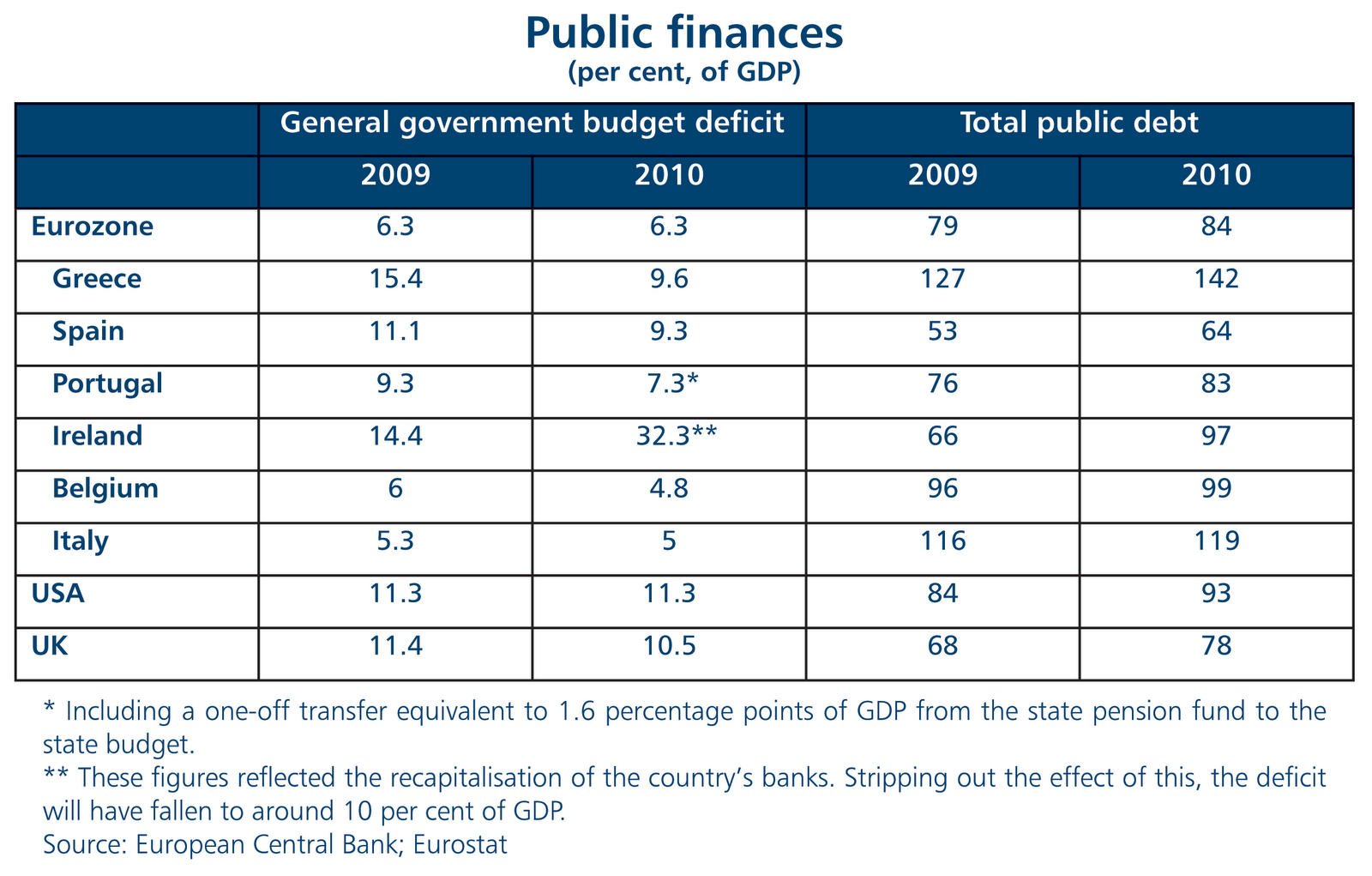
But anything more than a very superficial analysis shows why investors are right to be concerned about the eurozone. First, there is no federal eurozone budget, so the aggregate budget deficit is only of so much interest to investors. Second, it is countries’ ability to service their debts going forward that determines the risk premium demanded by investors, and to a large extent this depends on their economic growth prospects. While the crisis-hit eurozone economies have made more progress in reducing their borrowing than did either the UK or US, this has been at the cost of economic stagnation. Third, sovereign investors are not just concerned about public debt, but levels of private indebtedness too. They fear that if economic growth remains very weak, governments will end up being liable for some of the private debt.
Eurozone economic growth was a respectable enough 1.7 per cent in 2010 (see Table 2). This was well below the US, but about the same as the UK. However, the eurozone figures masked huge differences. Germany, which accounts for a third of the currency union’s GDP, expanded by 3.6 per cent, whereas Greece’s economy contracted steeply and a number of others barely grew. Stripping out Germany, eurozone economic growth was actually just 1 per cent in 2010. Indeed, the eurozone is still a long way from returning to its pre-crisis level of economic activity: in the third quarter of 2010 eurozone GDP was still 3.2 per cent lower than in the first quarter of 2008. This was better than the UK but far worse than the US, whose economy was almost 2 per cent larger in the third quarter of 2010 than at the outset of the downturn. Not only is real GDP in some of the struggling economies still way below their pre-crisis peaks, but there is little chance of them returning to pre-crisis levels any time soon.

Are investors right to be so pessimistic about the economic growth prospects of the struggling member-states? Yes, because their prospects of economic recovery rest on a strong rise in exports, but the principal way of bringing this about – real devaluation within the eurozone – threatens economic stagnation and rising debt burdens. Because of their membership of the currency union they cannot devalue their currencies, so must reduce their wages and prices relative to their eurozone counterparts. The problem is that this will depress income and lead to deflationary pressures. This, in turn, will make it hard to bring down deficits on a sustained basis (irrespective of how wrenching fiscal austerity is), and will inflate debt servicing costs. A strategy of deflating back to competitiveness might be do-able for an economy with little or no debt, but for the crisis-hit eurozone economies it is high-risk.
Portugal has combined public and private debt of around 320 per cent of GDP. The Portuguese central bank expects real GDP to contract by 1.3 per cent in 2011, while inflation is unlikely to be much more than 1.5 per cent. This implies stagnant nominal GDP (growth in real GDP and inflation). There was much fanfare this week when Portugal successfully sold a modest quantity of government bonds at a yield of 6.7 per cent, but this is a ruinous rate of interest for an economy with Portugal’s prospects. The picture is somewhat better in Spain (hence investors are demanding less of a premium to lend to the Spanish government). Ireland has managed to execute a major internal devaluation within the eurozone, but at the cost of an unprecedented decline in its nominal GDP and an explosion in the country’s debt burden. With Greece’s stock of public debt at 140 per cent of GDP and its economy contracting rapidly, it is hardly surprising that investors have little appetite for Greek bonds.
But what of the structural reforms being pushed through by these countries? Why are investors not taking more account of these? There is no doubt that Spain, Greece and Portugal are now introducing long overdue reforms of their labour markets. These reforms are obviously welcome, and in the long-term should help to boost productivity growth. But a little perspective is needed. Notwithstanding modest moves to free up the markets for professional services in Greece and Portugal, there is little sign of an aggressive drive to open-up these countries’ domestic sectors to more competition. And without such aggressive liberalisation, productivity growth will remain anaemic. Moreover, there are legitimate doubts over the ability of governments to push through an ongoing programme of unpopular reforms when their economies are caught in a cycle of weak economic growth and rising debt burdens. There needs to be light at the end of the tunnel.
What of debt dynamics in the UK and US? Are they not even worse? Both face daunting fiscal challenges and high levels of household indebtedness. And the US at least relies on foreign investors to finance a significant chunk of its budget deficit. But there are several good reasons for investors to be more relaxed about the solvency of the US (and to a somewhat lesser degree, the UK) than the crisis-hit members of the currency union. Unlike their eurozone counterparts, who must rely on deflation to rebalance their economies, the US and UK can rely on currency depreciation to facilitate the necessary adjustment and boost exports. Currency depreciation and very activist central banks in these two countries also ensures that deflation is unlikely to be problem. In addition, both countries have far more flexible product and labour markets than the southern European countries.
In short, the reason why the US and UK can borrow at much lower rates of interest than the similarly indebted members of the eurozone is that the obstacles to economic growth are lower in Britain and America and threat of deflation and mounting social tensions much less acute. Of course, investors could yet take fright if economic recovery in the two countries peters out and their fiscal deficits remain too high. The UK, more than the US, could certainly find itself in this position. But in such a situation, sterling would fall, encouraged no doubt by a further bout of so-called quantitative easing by the Bank of England. And fortunately for the British government, it largely relies on domestic institutional investors to fund its fiscal deficit; this is not so in the case of the currency union’s strugglers.
Unsustainable macroeconomic policies explain investors’ flight from the sovereign debt of the crisis-hit eurozone economies. Until the eurozone demonstrates how the currency union’s peripheral economies are going to avoid stagnation and debt traps, it will be rational for investors to give their sovereign debt a wide berth.
Simon Tilford is chief economist at the Centre for European Reform.
Thursday, January 13, 2011
Reflections on Tommaso Padoa-Schioppa and the euro
By Charles Grant
At the end of last year, Europe lost Tommaso Padoa-Schioppa, an eminent central banker and economist, and one of the founding fathers of the euro. As EU leaders struggle to cope with the continuing euro crisis, they would do well do ponder some of Padoa-Schioppa’s insights on the economics of monetary union.
Following Greece and Ireland, Portugal may soon require a rescue from its fellow eurozone members. With the benefit of hindsight it is only too evident that the euro has suffered from design flaws, and that European leaders have mismanaged the currency. Too many countries joined the euro before they were ready. Fiscal discipline has been too lax, though new rules will make it harder for governments to over-borrow. Some eurozone governments did far too little to promote structural reform, and have therefore suffered from inflexible economies and poor productivity; in 2010, Greece, Portugal and Spain belatedly implemented some structural reforms. The penal rates of interest at which Greece, Ireland and Portugal have had to borrow have revealed the need for a bail-out mechanism and a procedure for ensuring the relatively orderly restructuring of sovereign debt (both are on their way). The behaviour of many banks – and not only in Ireland and Spain – has shown that the tighter system of pan-European financial regulation now being put together is sorely needed.
The statesmen who designed the euro have been criticised for putting politics ahead of economics: motivated by the desire to promote European unification, they ignored the economics – or assumed that once the project got underway, the necessary rules for economic governance would somehow fall into place. There is truth in that criticism, but many people have forgotten that economics did play a role in the birth of the euro.
In 1987, Padoa-Schioppa wrote a report explaining that the exchange rate mechanism (ERM) – which limited fluctuations among many European currencies – could not survive the removal of exchange controls that was agreed in that year. He wrote: “The complete liberalisation of capital movements is inconsistent with the present combination of exchange rate stability and the considerable national autonomy in the conduct of monetary policy.” He also argued that the end of the ERM and the return of currency instability would endanger the single market.
This report convinced Jacques Delors, the then president of the European Commission, and other leaders, that moving towards economic and monetary union (EMU) was urgent. So in 1988 EU leaders tasked a committee – which had Delors as its chairman and Padoa-Schioppa as its joint rapporteur – with drawing up plans for EMU. Delors and Padoa-Schioppa got most of what they wanted, though the Germans forced them – reluctantly – to accept the principle of binding rules on budget deficits. Most of the Delors committee’s report ended up in the Maastricht treaty in 1991. The ERM would not have survived the currency crises of 1992 and 1993 – when the capital markets nearly tore it apart – without the momentum towards monetary union.
In 2000, when a member of the executive board of the European Central Bank (ECB), Padoa-Schioppa wrote a brilliant essay for the CER, ‘Europe’s new economic policy constitution’. He complained about the weakness of the arrangements for co-ordinating national fiscal policies, arguing that if the eurozone could develop its own fiscal stance, the ECB could better manage monetary policy and more easily keep down interest rates. He also warned that the eurozone would not work well unless governments made labour markets more flexible; doing so would facilitate “higher non-inflationary growth. This in turn would increase fiscal sustainability on both the income and expenditure sides of the budget.”
Padoa-Schioppa’s death has deprived Europe of a courteous public servant who was utterly committed to European unity. Many of his insights have long-lasting relevance, and not only on labour markets. The EU’s new procedure for a ‘European semester’, involving peer review of national budgets, is a step towards the fiscal co-ordination he called for. Above all, Padoa-Schioppa understood the relevance of the euro to the single market. If the euro disappeared, giving way to competitive devaluations and wild currency swings, there is a serious risk that member-states would either impose tariffs against each other or resort to hidden forms of protectionism. Alternatives to the euro would not look pretty.
Like Padoa-Schioppa, the CER has long argued that a healthy eurozone requires much more thorough economic reform. In the flurry of regulatory and institutional reforms now underway, one of the most serious underlying problems in the eurozone is not being addressed. This is the growing gap in competitiveness between the eurozone’s core in northern Europe, and the southern states. This has led to large current account imbalances within the eurozone, and these have left the southern countries struggling to grow and to pay back debts.
One economist who foresaw that these imbalances would be a problem was the CER’s Simon Tilford, whose remarkably prescient CER report, ‘Will the eurozone crack?’, was published in September 2006. Simon wrote: “The core problem is that membership seems to have reduced pressure on governments to undertake the reforms needed to ensure the currency union is a success. Freed from the risk of a currency crisis and higher debt service costs, Italy [and the other southern countries have] done little to strengthen public finances, make labour markets more flexible or introduce more competition. The result has been declining productivity, inflation above the eurozone average and a sharp decline in competitiveness relative to other members of the eurozone. Unable to devalue its currency, Italy now risks getting caught in a vicious circle of very slow economic growth and rising debt.”
Simon predicted, rightly, that the markets’ inability to distinguish between the debts of different eurozone countries would lead to a damaging lack of fiscal discipline. He also pointed out that Germany’s “de facto competitive devaluation”, through low wage growth, would exacerbate eurozone imbalances. “While this has massively boosted the country’s competitiveness and its exports, it has depressed consumption and investment, causing the country’s trade and current account surpluses to balloon. An economy as big as Germany’s cannot depend indefinitely on exports to drive real GDP growth, without imposing intolerable pressures on other members of EMU.” On the other hand, “a German economy growing under its own steam would boost demand across the eurozone, cushioning the impact of structural reforms, and crucially, make it easier for other member-states to restore their competitiveness without forcing their economies into a prolonged recession.”
One reason to be gloomy about the euro is the intellectual rift that divides European leaders. It is as though the doctors examining the patient do not agree on the diagnosis or the medicine required. At the risk of some generalisation, leaders from Germanic and Nordic cultures believe that stricter fiscal discipline and structural reform will suffice to cure the patient. Those from Latin and Anglo-Saxon cultures think that medicine is necessary but not sufficient: they also focus on the imbalances and the need for the core countries with external surpluses to generate demand in the eurozone.
Despite all the problems, I expect the euro to survive, because the political will of EU leaders – including those in Germany – to do what it takes to preserve the currency remains strong. But political will on its own will not suffice; Europe’s leaders must also listen to economists if they want to put the euro on a truly sustainable footing.
Charles Grant is director of the Centre for European Reform
At the end of last year, Europe lost Tommaso Padoa-Schioppa, an eminent central banker and economist, and one of the founding fathers of the euro. As EU leaders struggle to cope with the continuing euro crisis, they would do well do ponder some of Padoa-Schioppa’s insights on the economics of monetary union.
Following Greece and Ireland, Portugal may soon require a rescue from its fellow eurozone members. With the benefit of hindsight it is only too evident that the euro has suffered from design flaws, and that European leaders have mismanaged the currency. Too many countries joined the euro before they were ready. Fiscal discipline has been too lax, though new rules will make it harder for governments to over-borrow. Some eurozone governments did far too little to promote structural reform, and have therefore suffered from inflexible economies and poor productivity; in 2010, Greece, Portugal and Spain belatedly implemented some structural reforms. The penal rates of interest at which Greece, Ireland and Portugal have had to borrow have revealed the need for a bail-out mechanism and a procedure for ensuring the relatively orderly restructuring of sovereign debt (both are on their way). The behaviour of many banks – and not only in Ireland and Spain – has shown that the tighter system of pan-European financial regulation now being put together is sorely needed.
The statesmen who designed the euro have been criticised for putting politics ahead of economics: motivated by the desire to promote European unification, they ignored the economics – or assumed that once the project got underway, the necessary rules for economic governance would somehow fall into place. There is truth in that criticism, but many people have forgotten that economics did play a role in the birth of the euro.
In 1987, Padoa-Schioppa wrote a report explaining that the exchange rate mechanism (ERM) – which limited fluctuations among many European currencies – could not survive the removal of exchange controls that was agreed in that year. He wrote: “The complete liberalisation of capital movements is inconsistent with the present combination of exchange rate stability and the considerable national autonomy in the conduct of monetary policy.” He also argued that the end of the ERM and the return of currency instability would endanger the single market.
This report convinced Jacques Delors, the then president of the European Commission, and other leaders, that moving towards economic and monetary union (EMU) was urgent. So in 1988 EU leaders tasked a committee – which had Delors as its chairman and Padoa-Schioppa as its joint rapporteur – with drawing up plans for EMU. Delors and Padoa-Schioppa got most of what they wanted, though the Germans forced them – reluctantly – to accept the principle of binding rules on budget deficits. Most of the Delors committee’s report ended up in the Maastricht treaty in 1991. The ERM would not have survived the currency crises of 1992 and 1993 – when the capital markets nearly tore it apart – without the momentum towards monetary union.
In 2000, when a member of the executive board of the European Central Bank (ECB), Padoa-Schioppa wrote a brilliant essay for the CER, ‘Europe’s new economic policy constitution’. He complained about the weakness of the arrangements for co-ordinating national fiscal policies, arguing that if the eurozone could develop its own fiscal stance, the ECB could better manage monetary policy and more easily keep down interest rates. He also warned that the eurozone would not work well unless governments made labour markets more flexible; doing so would facilitate “higher non-inflationary growth. This in turn would increase fiscal sustainability on both the income and expenditure sides of the budget.”
Padoa-Schioppa’s death has deprived Europe of a courteous public servant who was utterly committed to European unity. Many of his insights have long-lasting relevance, and not only on labour markets. The EU’s new procedure for a ‘European semester’, involving peer review of national budgets, is a step towards the fiscal co-ordination he called for. Above all, Padoa-Schioppa understood the relevance of the euro to the single market. If the euro disappeared, giving way to competitive devaluations and wild currency swings, there is a serious risk that member-states would either impose tariffs against each other or resort to hidden forms of protectionism. Alternatives to the euro would not look pretty.
Like Padoa-Schioppa, the CER has long argued that a healthy eurozone requires much more thorough economic reform. In the flurry of regulatory and institutional reforms now underway, one of the most serious underlying problems in the eurozone is not being addressed. This is the growing gap in competitiveness between the eurozone’s core in northern Europe, and the southern states. This has led to large current account imbalances within the eurozone, and these have left the southern countries struggling to grow and to pay back debts.
One economist who foresaw that these imbalances would be a problem was the CER’s Simon Tilford, whose remarkably prescient CER report, ‘Will the eurozone crack?’, was published in September 2006. Simon wrote: “The core problem is that membership seems to have reduced pressure on governments to undertake the reforms needed to ensure the currency union is a success. Freed from the risk of a currency crisis and higher debt service costs, Italy [and the other southern countries have] done little to strengthen public finances, make labour markets more flexible or introduce more competition. The result has been declining productivity, inflation above the eurozone average and a sharp decline in competitiveness relative to other members of the eurozone. Unable to devalue its currency, Italy now risks getting caught in a vicious circle of very slow economic growth and rising debt.”
Simon predicted, rightly, that the markets’ inability to distinguish between the debts of different eurozone countries would lead to a damaging lack of fiscal discipline. He also pointed out that Germany’s “de facto competitive devaluation”, through low wage growth, would exacerbate eurozone imbalances. “While this has massively boosted the country’s competitiveness and its exports, it has depressed consumption and investment, causing the country’s trade and current account surpluses to balloon. An economy as big as Germany’s cannot depend indefinitely on exports to drive real GDP growth, without imposing intolerable pressures on other members of EMU.” On the other hand, “a German economy growing under its own steam would boost demand across the eurozone, cushioning the impact of structural reforms, and crucially, make it easier for other member-states to restore their competitiveness without forcing their economies into a prolonged recession.”
One reason to be gloomy about the euro is the intellectual rift that divides European leaders. It is as though the doctors examining the patient do not agree on the diagnosis or the medicine required. At the risk of some generalisation, leaders from Germanic and Nordic cultures believe that stricter fiscal discipline and structural reform will suffice to cure the patient. Those from Latin and Anglo-Saxon cultures think that medicine is necessary but not sufficient: they also focus on the imbalances and the need for the core countries with external surpluses to generate demand in the eurozone.
Despite all the problems, I expect the euro to survive, because the political will of EU leaders – including those in Germany – to do what it takes to preserve the currency remains strong. But political will on its own will not suffice; Europe’s leaders must also listen to economists if they want to put the euro on a truly sustainable footing.
Charles Grant is director of the Centre for European Reform
Friday, December 17, 2010
Has Ukraine lost appetite for reforms?
In a study on Ukraine published in October, the CER gave President Viktor Yanukovich credit for passing difficult economic reforms but criticised his efforts to suppress political opposition. Since then, reforms have stalled while the concentration of power in the president's hands has continued unabated.
A recent visit to Kyiv has left me deeply worried. The government continues to amass power. This is in part due to the weakness of the opposition – former leaders of the Orange revolution such as former president Viktor Yushchenko and former prime minister Yulia Tymoshenko are genuinely unpopular with voters, who blame them for disappointing economic performance and failure to move Ukraine closer to the EU. Even so, President Yanukovich seems intent on preventing free and fair elections. The October 31st regional poll was marred by widespread use of government powers to help the ruling Party of Regions. The European Parliament notes in its November 25th resolution that "some parties, such as [Yulia Tymoshenko's] Batkivshchyna, were unable to register their candidates". Phil Gordon, the US assistant secretary of state, said that the United States: "does not believe that those elections met the standards of openness and fairness that applied to the presidential election earlier in the year."
The story is not much better on the economic front. Even in those areas, where progress had been made, the government has started to backpedal. For example, the new public procurement law, which the EU helped to draft earlier this year, is being riddled by exceptions: the country's parliament has exempted work on sites for the 2012 European football championship. The EU has viewed the law as key to countering corruption, and its partial reversal dismayed EU ambassadors in Kyiv. Economists also say that the government cheated to comply with a key requirement from the International Monetary Fund (IMF): in order to cut tax refund arrears it simply stopped accepting claims. The IMF is due to decide this month on whether to disburse further aid to Ukraine.
There has been little progress on reforming the country's all-important gas sector. The government has increased domestic gas prices, which has helped to improve the finances of Naftogaz, the country's monopoly – and perennially insolvent – importer and distributor of gas. But there has been no progress on making the company more efficient and transparent. In September 2010 Ukraine acceded to the EU's 'energy community', which groups countries that pledge to uphold each other's security of supply, on the condition that the government separates Naftogaz's gas transit pipelines from other businesses. The Ukrainian parliament passed legislation in July that had ordered Naftogaz to do just that. But nothing has changed: Naftogaz remains untouched and important secondary legislation – to create an independent regulator, for example – is not even under consideration. Meanwhile, Naftogaz is descending into deeper financial trouble. A court in Ukraine has ordered the company to repay nearly $4 billion to one of Ukraine's most powerful businessmen, Dmytro Firtash, who had sued for damages incurred when the previous government cancelled the services of his company in brokering gas purchases from Russia. It is not obvious that Naftogaz has enough money or gas to reimburse Firtash.
The government recently passed a law that would make it easier to explore oil reserves in the Black Sea. These could in the long run lessen Ukraine's dependence on energy imports from Russia. But to extract the reserves, Ukraine needs foreign expertise. So it is baffling that the government has recently imposed a new 40 per cent duty on imports of refined oil (punishing Shell, a key importer) and increased royalties on gas and oil extracted in Ukraine. Foreign energy majors will have little reason to invest in the country. One representative of a Western energy major says that "there is plenty of gas here, in shale and under sea, but no one will tap it because there is zero confidence among investors that they would ever see their money back." Non-energy companies are treated similarly. Deutsche Telekom and Norway's Telenor wanted to buy Ukraine's national telecommunications operator, Ukrtelecom, but the Kyiv government excluded them from the privatisation on a technicality.
Curiously, while the economic reforms have stuttered, relations with the EU have improved, though from a low point. At an EU-Ukraine summit in November, the parties agreed a 'road map' which may eventually allow the Ukrainians to travel to the EU without visas. Talks on a new 'deep and comprehensive free trade agreement' (DCFTA) have also been resumed, after months of paralysis. When the European Commission had threatened in October to cut off talks altogether, President Yanukovich ordered Prime Minister Mykola Azarov "to make all necessary concessions" to restart negotiations. But the order itself is symptomatic of what is wrong with the relationship: Kyiv only pays attention when talks are about to collapse; even then it takes short-term measures: nothing is being done to assess the economic impact of DCFTA on Ukrainian industries or to encourage the losers to move into new lines of business. This guarantees that some of the country's politically powerful oligarchs will eventually revolt against DCFTA.
The EU has limited tools to press for greater political freedoms and proper economic reforms but it is not powerless. The Ukrainians do care what the EU states and institutions think. They have cheered the European Parliament’s November resolution, in which, for the first time, an EU institution (albeit one without decision-making powers in the matter) says that "Ukraine has the right to apply for membership" (something that the Council of Ministers has been reluctant to say). EU High Representative for Foreign Policy Catherine Ashton and senior national diplomats should speak out more forcefully about the state of democracy in Ukraine. EU governments should also use their influence in the IMF to demand real economic reforms. The IMF loans represent the most important leverage that the European governments and the US have in Ukraine today. The current government in Kyiv is capable of tough choices, but only when it feels real pressure.
Tomas Valasek is director of foreign policy and defence at the Centre for European Reform.
A recent visit to Kyiv has left me deeply worried. The government continues to amass power. This is in part due to the weakness of the opposition – former leaders of the Orange revolution such as former president Viktor Yushchenko and former prime minister Yulia Tymoshenko are genuinely unpopular with voters, who blame them for disappointing economic performance and failure to move Ukraine closer to the EU. Even so, President Yanukovich seems intent on preventing free and fair elections. The October 31st regional poll was marred by widespread use of government powers to help the ruling Party of Regions. The European Parliament notes in its November 25th resolution that "some parties, such as [Yulia Tymoshenko's] Batkivshchyna, were unable to register their candidates". Phil Gordon, the US assistant secretary of state, said that the United States: "does not believe that those elections met the standards of openness and fairness that applied to the presidential election earlier in the year."
The story is not much better on the economic front. Even in those areas, where progress had been made, the government has started to backpedal. For example, the new public procurement law, which the EU helped to draft earlier this year, is being riddled by exceptions: the country's parliament has exempted work on sites for the 2012 European football championship. The EU has viewed the law as key to countering corruption, and its partial reversal dismayed EU ambassadors in Kyiv. Economists also say that the government cheated to comply with a key requirement from the International Monetary Fund (IMF): in order to cut tax refund arrears it simply stopped accepting claims. The IMF is due to decide this month on whether to disburse further aid to Ukraine.
There has been little progress on reforming the country's all-important gas sector. The government has increased domestic gas prices, which has helped to improve the finances of Naftogaz, the country's monopoly – and perennially insolvent – importer and distributor of gas. But there has been no progress on making the company more efficient and transparent. In September 2010 Ukraine acceded to the EU's 'energy community', which groups countries that pledge to uphold each other's security of supply, on the condition that the government separates Naftogaz's gas transit pipelines from other businesses. The Ukrainian parliament passed legislation in July that had ordered Naftogaz to do just that. But nothing has changed: Naftogaz remains untouched and important secondary legislation – to create an independent regulator, for example – is not even under consideration. Meanwhile, Naftogaz is descending into deeper financial trouble. A court in Ukraine has ordered the company to repay nearly $4 billion to one of Ukraine's most powerful businessmen, Dmytro Firtash, who had sued for damages incurred when the previous government cancelled the services of his company in brokering gas purchases from Russia. It is not obvious that Naftogaz has enough money or gas to reimburse Firtash.
The government recently passed a law that would make it easier to explore oil reserves in the Black Sea. These could in the long run lessen Ukraine's dependence on energy imports from Russia. But to extract the reserves, Ukraine needs foreign expertise. So it is baffling that the government has recently imposed a new 40 per cent duty on imports of refined oil (punishing Shell, a key importer) and increased royalties on gas and oil extracted in Ukraine. Foreign energy majors will have little reason to invest in the country. One representative of a Western energy major says that "there is plenty of gas here, in shale and under sea, but no one will tap it because there is zero confidence among investors that they would ever see their money back." Non-energy companies are treated similarly. Deutsche Telekom and Norway's Telenor wanted to buy Ukraine's national telecommunications operator, Ukrtelecom, but the Kyiv government excluded them from the privatisation on a technicality.
Curiously, while the economic reforms have stuttered, relations with the EU have improved, though from a low point. At an EU-Ukraine summit in November, the parties agreed a 'road map' which may eventually allow the Ukrainians to travel to the EU without visas. Talks on a new 'deep and comprehensive free trade agreement' (DCFTA) have also been resumed, after months of paralysis. When the European Commission had threatened in October to cut off talks altogether, President Yanukovich ordered Prime Minister Mykola Azarov "to make all necessary concessions" to restart negotiations. But the order itself is symptomatic of what is wrong with the relationship: Kyiv only pays attention when talks are about to collapse; even then it takes short-term measures: nothing is being done to assess the economic impact of DCFTA on Ukrainian industries or to encourage the losers to move into new lines of business. This guarantees that some of the country's politically powerful oligarchs will eventually revolt against DCFTA.
The EU has limited tools to press for greater political freedoms and proper economic reforms but it is not powerless. The Ukrainians do care what the EU states and institutions think. They have cheered the European Parliament’s November resolution, in which, for the first time, an EU institution (albeit one without decision-making powers in the matter) says that "Ukraine has the right to apply for membership" (something that the Council of Ministers has been reluctant to say). EU High Representative for Foreign Policy Catherine Ashton and senior national diplomats should speak out more forcefully about the state of democracy in Ukraine. EU governments should also use their influence in the IMF to demand real economic reforms. The IMF loans represent the most important leverage that the European governments and the US have in Ukraine today. The current government in Kyiv is capable of tough choices, but only when it feels real pressure.
Tomas Valasek is director of foreign policy and defence at the Centre for European Reform.
Thursday, December 09, 2010
Eurozone: Time for damage limitation
by Simon Tilford
Time is running out to prevent the eurozone crisis from imperilling Europe's banking system and with it the integrity of the currency union. It is beholden on policy-makers to minimise the economic (and hence political costs) to the EU. Three things need to happen: the debts of Greece, Ireland and Portugal need to be restructured as soon as possible; the European Commission and the European Central Bank (ECB) need to do everything to make sure that the adjustments facing the other struggling euro economies are realistic; and there needs to be policy co-ordination between the member-states aimed at ensuring balanced economic growth across the currency union. This requires leadership and an honest and better informed debate about the causes of the crisis. Both are in short supply.
The adjustments facing Greece, Ireland or Portugal were always a tall order. Now that borrowing costs have ballooned, those adjustments are impossible. Under no plausible economic growth forecasts will these economies be able to pay back their debts. However, eurozone policy-makers continue to treat the crisis as one of liquidity rather than solvency, providing indebted member-states with loans (at punitive interest rates) but doing nothing to improve their chances of being able to service them. This is the worst of all possible worlds. Investors have taken fright and pushed up the borrowing costs of countries whose debts might otherwise have proved manageable. Far from limiting creditor losses, they risk spiralling out of control. Piling up more debt when solvency (not liquidity) is the issue is self-defeating.
The bail-out of Ireland simply increases that country's already unsustainable levels of debt, while insulating investors. The ECB and the Commission opposed restructuring the debts of the Irish banking sector. Instead, they have argued for ever more implausible degrees of fiscal austerity in return for extending costly loans. Unsurprisingly, the Irish government's borrowing costs remain prohibitively high. A bail-out of Portugal will be similarly ineffective. It will benefit lucky investors, but do nothing to improve Portugal's prospects. The loss of confidence in the eurozone and resulting surge in borrowing costs threatens to draw Spain into the insolvent camp, ultimately requiring a Spanish debt restructuring. This would be catastrophic for Europe's banks and would impose huge fiscal costs.
Of course, restructuring the debts of Greece, Ireland and Portugal will be costly for creditors. But if debt positions are unsustainable the problem needs to be addressed sooner rather than later. Banks based in eurozone members such as France and Germany, as well as in non-eurozone countries such as the UK and US, would suffer big losses on their investments in the defaulting countries. The ECB would also book losses. This would be messy and governments would have to bite the bullet and recapitalise their banks. But it would ultimately prove less damaging to economies such as Ireland, Greece and Portugal, and the currency union as a whole, than persisting on a course that promises an even bigger restructuring (and bigger losses) down the line.
The second part of the strategy would be to ensure that the adjustment process facing Spain and other hard-hit economies is a manageable one. The ECB could help by launching an aggressive programme of government bond purchases. Monies from the European Financial Stability Fund (EFSF) could also be used to tide the countries over until they regain access to the financial markets on affordable terms. But these countries' fiscal programmes will also have to be consistent with a return to decent economic growth. Crucially, cuts in spending on education and infrastructure must be kept to a minimum, as these would further reduce growth potential. Reforms of pension and healthcare systems would go a long way to address investors' concerns about the long-term sustainability of countries' fiscal positions.
The third part of the strategy – rebalancing economic growth in the eurozone – will be the hardest to execute, but is essential if future crises are to be avoided. Governments need to support the Commission's drive to foster closer economic integration and to co-ordinate their policies to ensure that they are compatible with balanced economic growth across the eurozone. Huge current account balances are not consistent with a stable currency union, because one way or another they require massive (and hence politically and economically destabilising) transfers between the participating economies. However, even if trade imbalances are reduced, there will have to be greater fiscal supra-nationalism. This could take the form of a common E-bond, some minimal fiscal union, or ideally a combination of the two. Without some element of fiscal supra-nationalism, the adjustment costs facing countries that cede trade competitiveness within the eurozone will simply be too high.
However unpalatable these measures are to eurozone governments, the European Commission and the ECB, they can all be done if governments can summon the political will. Governments have to explain to their voters why debt relief for Greece, Ireland and Portugal and the resulting injection of public funds into banks is necessary in order to head off far greater costs down the line. They have to summon the political courage to make the case for greater economic integration. A fiscal union can also be fashioned in such a way that limits moral hazard. But all of this requires leadership, not least from Germany. The fact that the alternative – a series of ever larger and ineffective bail-outs, culminating in far bigger defaults and a systemic banking sector crash – is much worse, ought to focus minds. After all, under that scenario the political glue holding the union together could dissolve altogether.
Simon Tilford is chief economist at the Centre for European Reform.
Time is running out to prevent the eurozone crisis from imperilling Europe's banking system and with it the integrity of the currency union. It is beholden on policy-makers to minimise the economic (and hence political costs) to the EU. Three things need to happen: the debts of Greece, Ireland and Portugal need to be restructured as soon as possible; the European Commission and the European Central Bank (ECB) need to do everything to make sure that the adjustments facing the other struggling euro economies are realistic; and there needs to be policy co-ordination between the member-states aimed at ensuring balanced economic growth across the currency union. This requires leadership and an honest and better informed debate about the causes of the crisis. Both are in short supply.
The adjustments facing Greece, Ireland or Portugal were always a tall order. Now that borrowing costs have ballooned, those adjustments are impossible. Under no plausible economic growth forecasts will these economies be able to pay back their debts. However, eurozone policy-makers continue to treat the crisis as one of liquidity rather than solvency, providing indebted member-states with loans (at punitive interest rates) but doing nothing to improve their chances of being able to service them. This is the worst of all possible worlds. Investors have taken fright and pushed up the borrowing costs of countries whose debts might otherwise have proved manageable. Far from limiting creditor losses, they risk spiralling out of control. Piling up more debt when solvency (not liquidity) is the issue is self-defeating.
The bail-out of Ireland simply increases that country's already unsustainable levels of debt, while insulating investors. The ECB and the Commission opposed restructuring the debts of the Irish banking sector. Instead, they have argued for ever more implausible degrees of fiscal austerity in return for extending costly loans. Unsurprisingly, the Irish government's borrowing costs remain prohibitively high. A bail-out of Portugal will be similarly ineffective. It will benefit lucky investors, but do nothing to improve Portugal's prospects. The loss of confidence in the eurozone and resulting surge in borrowing costs threatens to draw Spain into the insolvent camp, ultimately requiring a Spanish debt restructuring. This would be catastrophic for Europe's banks and would impose huge fiscal costs.
Of course, restructuring the debts of Greece, Ireland and Portugal will be costly for creditors. But if debt positions are unsustainable the problem needs to be addressed sooner rather than later. Banks based in eurozone members such as France and Germany, as well as in non-eurozone countries such as the UK and US, would suffer big losses on their investments in the defaulting countries. The ECB would also book losses. This would be messy and governments would have to bite the bullet and recapitalise their banks. But it would ultimately prove less damaging to economies such as Ireland, Greece and Portugal, and the currency union as a whole, than persisting on a course that promises an even bigger restructuring (and bigger losses) down the line.
The second part of the strategy would be to ensure that the adjustment process facing Spain and other hard-hit economies is a manageable one. The ECB could help by launching an aggressive programme of government bond purchases. Monies from the European Financial Stability Fund (EFSF) could also be used to tide the countries over until they regain access to the financial markets on affordable terms. But these countries' fiscal programmes will also have to be consistent with a return to decent economic growth. Crucially, cuts in spending on education and infrastructure must be kept to a minimum, as these would further reduce growth potential. Reforms of pension and healthcare systems would go a long way to address investors' concerns about the long-term sustainability of countries' fiscal positions.
The third part of the strategy – rebalancing economic growth in the eurozone – will be the hardest to execute, but is essential if future crises are to be avoided. Governments need to support the Commission's drive to foster closer economic integration and to co-ordinate their policies to ensure that they are compatible with balanced economic growth across the eurozone. Huge current account balances are not consistent with a stable currency union, because one way or another they require massive (and hence politically and economically destabilising) transfers between the participating economies. However, even if trade imbalances are reduced, there will have to be greater fiscal supra-nationalism. This could take the form of a common E-bond, some minimal fiscal union, or ideally a combination of the two. Without some element of fiscal supra-nationalism, the adjustment costs facing countries that cede trade competitiveness within the eurozone will simply be too high.
However unpalatable these measures are to eurozone governments, the European Commission and the ECB, they can all be done if governments can summon the political will. Governments have to explain to their voters why debt relief for Greece, Ireland and Portugal and the resulting injection of public funds into banks is necessary in order to head off far greater costs down the line. They have to summon the political courage to make the case for greater economic integration. A fiscal union can also be fashioned in such a way that limits moral hazard. But all of this requires leadership, not least from Germany. The fact that the alternative – a series of ever larger and ineffective bail-outs, culminating in far bigger defaults and a systemic banking sector crash – is much worse, ought to focus minds. After all, under that scenario the political glue holding the union together could dissolve altogether.
Simon Tilford is chief economist at the Centre for European Reform.
Subscribe to:
Posts (Atom)